August 13, 2026
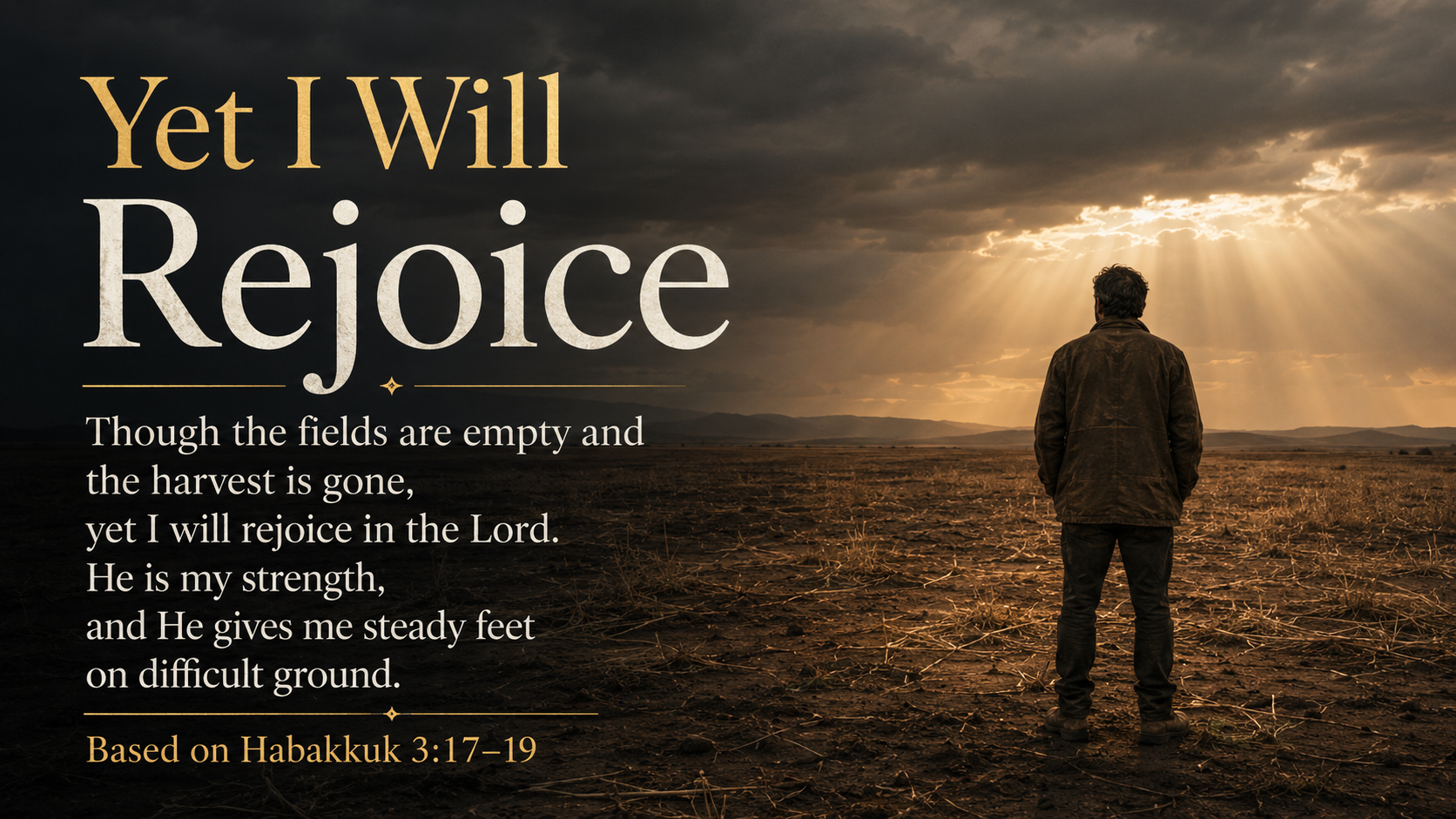
Habakkuk imagines a season in which crops fail, fields produce no food, and livestock disappear. Even when every visible source of security is gone, he chooses to rejoice in God his Savior. He trusts that the Lord will be his strength and give him steady footing in difficult places.
Devotional: Habakkuk describes a season in which nearly every visible sign of security has failed. The fig tree doesn’t bud. The vines bear no grapes. The fields produce no food. The stalls are empty. For an agricultural people, this isn’t a minor disappointment. It is economic loss, hunger, uncertainty, and fear about the future.
Yet Habakkuk says, “Yet I will rejoice in the Lord.” The word “yet” is one of the strongest words of faith in Scripture. It doesn’t erase what came before it. The fields are still empty. The losses are still real. The future is still uncertain. Yet the prophet refuses to let visible circumstances become the measure of God’s faithfulness.
Rejoicing in God isn’t the same as celebrating pain. It isn’t pretending that loss doesn’t hurt or that fear is unreasonable. Habakkuk isn’t thankful for the empty stalls. He is choosing to remember that God remains worthy of trust even when the usual signs of blessing disappear.
Many of us are comfortable trusting God when we can see provision taking shape. It’s harder when the answer is delayed, the plan falls apart, or what once gave us stability is no longer there. In those moments, faith asks a difficult question: Is God still enough when the evidence I wanted is missing?
Habakkuk answers by calling God his Savior and strength. He compares the steadiness God gives him to the sure-footedness of a deer moving across high places. The ground may be steep, but God makes it possible to stand.
That promise doesn’t mean we’ll never tremble. It means fear doesn’t have to choose our footing. We can grieve honestly and still turn toward God. We can name what is empty and still trust the One who isn’t.
There may be places in our lives where we’re waiting for fruit that hasn’t appeared. A prayer remains unanswered. A relationship hasn’t healed. A hoped-for future looks uncertain. Habakkuk gives us words for that place: “Yet I will rejoice.”
This isn’t shallow positivity. It’s deep trust. It looks beyond what is missing and fixes its hope on the God whose love, grace, and strength remain.
The prophet teaches us that worship can become an act of resistance against despair. We may not control the harvest, but we can choose where our hope will take root.
Action: Complete this sentence in writing: “Even though __________, yet I will trust the Lord because __________.” Let both parts be honest, naming the struggle and the truth you choose to remember.
Prayer: God my Savior, You know the empty places in my life and the hopes that haven’t produced fruit. Help me be honest about disappointment without surrendering to despair. When visible signs of security fail, remind me that Your love and faithfulness remain. Give me steady footing on difficult ground. Teach me to worship You not because everything is easy, but because You are still good and still near. Let my hope take root in You. In Jesus’ name I pray. Amen.
Thought for the Day: What is missing from my life cannot erase the faithfulness of God.
Habakkuk looked across empty fields, failed crops, and disappearing security, yet he made a courageous choice: “Yet I will rejoice in the Lord.” His joy didn’t deny the loss. It declared that loss would not have the final word.
Faith doesn’t require us to pretend everything is fine. We can name what is empty, grieve what has been lost, and still trust the God whose grace remains. We may not control the harvest, but we can choose where our hope takes root.