August 4, 2026
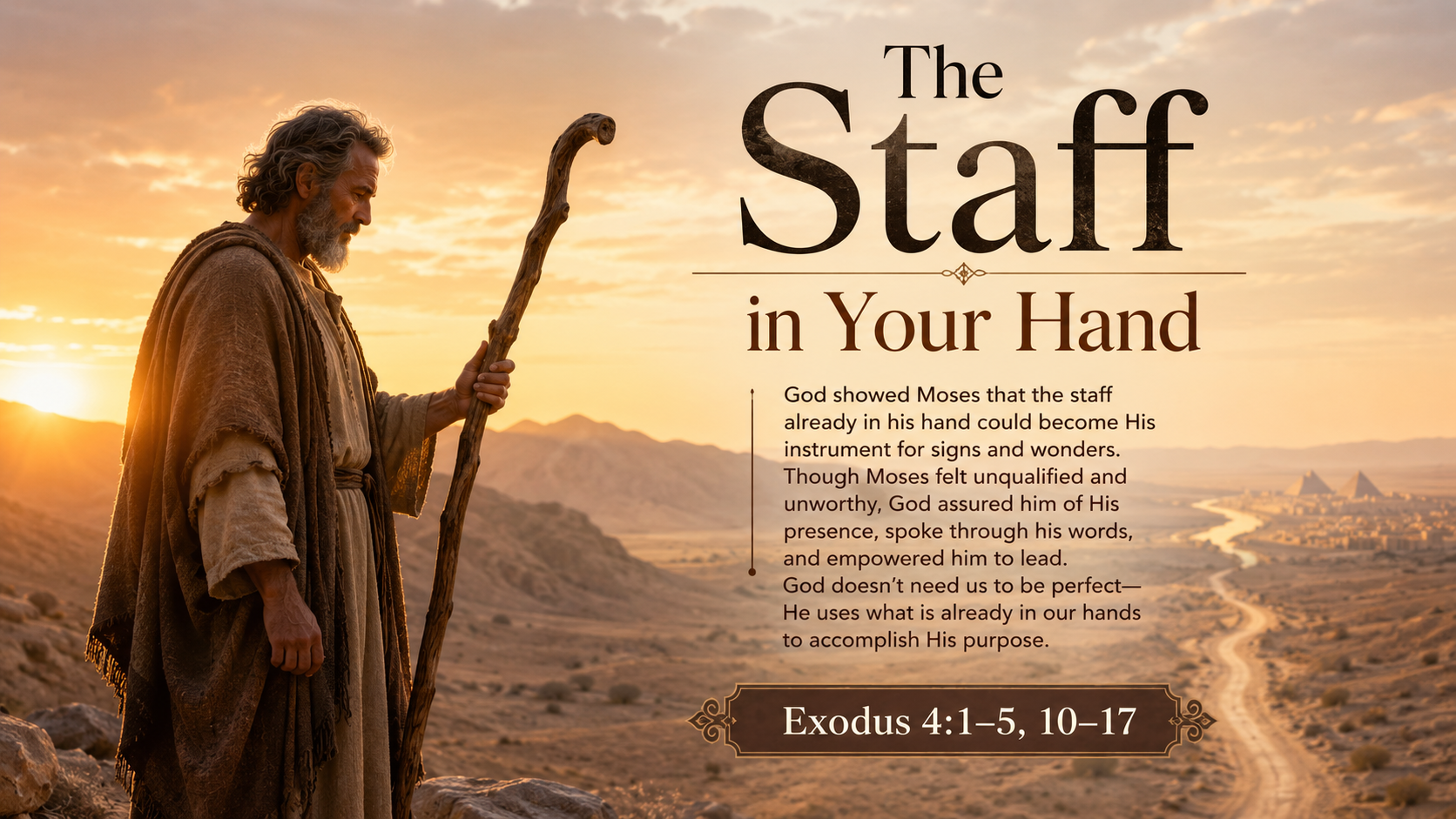
Moses doubts that the Israelites will believe God sent him and argues that he isn’t an effective speaker. God asks Moses what he holds in his hand. It is an ordinary shepherd’s staff, but God uses it as a sign of His power. God also promises to help Moses speak and sends Aaron to assist him. Moses is called to move forward using what God has already given him.
Devotional: Moses has plenty of reasons why he shouldn’t be the person God sends to Egypt. He worries that the Israelites won’t believe him. He remembers his failures. He admits that speaking doesn’t come easily to him. Every time God answers one concern, Moses finds another.
His hesitation is understandable. God is asking him to confront Pharaoh, lead an oppressed people out of slavery, and return to a place connected with painful memories. Moses knows how large the assignment is, and he knows how limited he feels.
Then God asks a simple question: “What is that in your hand?”
Moses is holding a staff. There’s nothing impressive about it. It is the tool of a shepherd, worn smooth through ordinary use. It represents the quiet life Moses has been living far from Egypt. Yet God takes something connected with Moses’ daily work and uses it as part of Israel’s deliverance.
The staff itself has no power. It isn’t a magical object. Its importance comes from the God who tells Moses how to use it. The ordinary becomes significant because it is surrendered to God’s purpose.
We may spend so much time wishing for gifts we don’t have that we fail to notice what God has already placed in our hands. We compare ourselves with people who speak more confidently, lead more naturally, or seem better prepared. We imagine that God could use us if we were more talented, more experienced, or less afraid.
God doesn’t deny Moses’ limitations. He promises to be with him in them. God says He will help Moses speak, and He provides Aaron as a partner. Moses doesn’t have to become someone else before he can obey. He needs to trust that God’s presence will be enough for the calling.
The same grace meets us. God may not remove every weakness, but He doesn’t abandon us because of them. He works through our experiences, relationships, skills, and even places where we feel inadequate. He also gives us people who can help carry the work.
Jesus didn’t build His Church around flawless people. He called fishermen, tax collectors, doubters, and people who often misunderstood Him. Their usefulness came from His presence and the transforming work of grace.
Look again at what is in your hand. It may be a practical skill, a story of survival, a gift for listening, a kitchen table, a vehicle, a telephone, or time you can share. It may look as ordinary as a shepherd’s staff. God can use it when it is offered in faith.
Action: Write down three abilities, experiences, relationships, or resources already available to you. Ask God how one of them might serve someone this week.
Prayer: Patient God, I often focus on my weaknesses and assume they disqualify me from Your work. Thank You for meeting me with grace rather than condemnation. Help me recognize what You have already placed in my hands. Teach me to offer my gifts without comparing myself with others. When I feel hesitant, remind me that You will be present and that I don’t have to serve alone. Use my ordinary life to reveal Your love, and give me courage to follow where You lead. In Jesus’ name I pray. Amen.
Thought for the Day: God often begins His work with something already in our hands.
Moses looked at the calling before him and saw every reason he wasn’t enough. He wasn’t confident, he didn’t think people would believe him, and speaking didn’t come easily. God didn’t ask Moses to become someone else. He asked him to notice the ordinary staff already in his hand.
Exodus 4 reminds us that God can use familiar tools, imperfect people, and gifts we may take for granted. The power wasn’t in Moses’ staff. The power belonged to God. Before deciding that you have nothing to offer, look again at what God has already placed within your reach.