
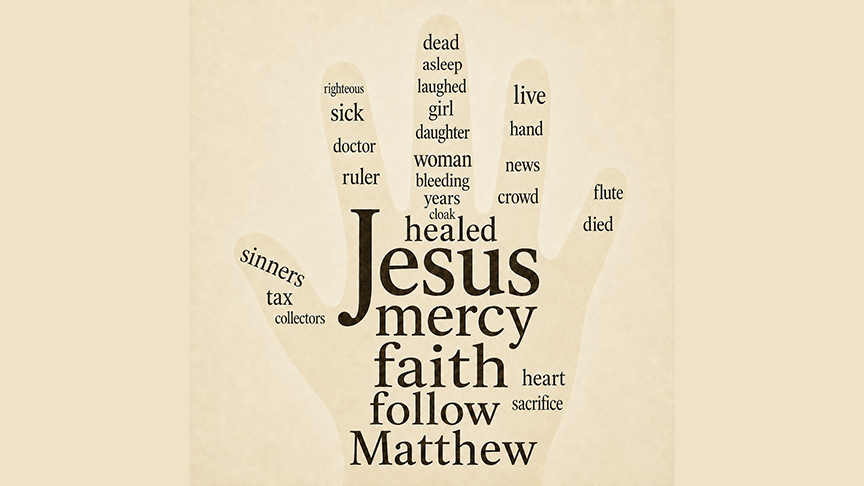
Matthew 9:9–13 and Matthew 9:18–26 speak into the places where people have been labeled, pushed aside, worn down, or told they don’t belong. These two scenes may seem separate at first. One happens at a tax booth and around a dinner table. The other unfolds between a desperate ruler, a suffering woman, and a dead child. Yet Matthew places them close together for a reason. Both passages show Jesus moving toward people others might avoid. He calls the sinner. He touches the unclean. He enters the house of grief. He restores what everyone else has written off.
The call of Matthew begins with a man sitting at a tax collector’s booth. That detail matters. Matthew isn’t in a synagogue praying for a fresh start. He isn’t presenting himself as spiritually ready. He’s doing the work that has made him despised in his own community. Tax collectors were often viewed as collaborators with Rome and as people who profited from the burdens of their neighbors (France). Yet Jesus looks at Matthew and says, “Follow me.” No lecture first. No probation period. No demand that Matthew prove he’s serious before Jesus offers grace. The call itself becomes the moment of mercy.
Then Jesus shares a meal with tax collectors and sinners. In the ancient world, table fellowship meant more than eating food in the same room. It expressed welcome, association, and relationship (Keener). That’s why the Pharisees object. They don’t merely question Jesus’ manners. They question His holiness. How can someone claiming to represent God sit so comfortably with people whose lives look spiritually compromised? Jesus answers with mercy. The sick need a doctor. God desires mercy, not sacrifice. Jesus doesn’t deny sin. He names the need clearly. But He refuses to let sin have the last word over a person’s identity.
The second passage carries that same mercy into deeper pain. A ruler comes to Jesus because his daughter has died, or is at the point of death. A woman who has suffered from bleeding for twelve years reaches for the edge of Jesus’ cloak. Both are desperate. Both are beyond ordinary help. Both come to Jesus with faith that may not be polished, but is real. Jesus responds, not with distance, but with compassion and authority. He calls the woman “daughter.” He takes the dead girl by the hand. In both moments, grace crosses boundaries that fear and religion often build.
These passages remind us that Jesus doesn’t avoid messy people, broken homes, public shame, physical suffering, or deep grief. He steps right into them. Grace doesn’t wait until people are cleaned up, respectable, healed, or strong. Grace comes near while they’re still sitting at the booth, still bleeding in the crowd, still grieving in the house. That is good news for sinners, sufferers, skeptics, and saints who are tired of pretending they’re fine.
Origin and Name
The Gospel takes its name from Matthew, also known as Levi, a tax collector
who became one of Jesus’ twelve disciples. That matters because Matthew’s own
calling reflects one of the Gospel’s central convictions: Jesus brings grace to
people others have written off. A tax collector becoming a disciple and witness
fits the larger story of a Messiah who calls sinners, heals outsiders, and
forms a new people by mercy (France).
Authorship
Early Christian tradition connects this Gospel with Matthew the apostle. The
Gospel itself does not name its author, but it shows deep knowledge of Jewish
Scripture, careful theological structure, and concern for the life and teaching
of the Church. It presents Jesus as the fulfillment of Israel’s story and the
authoritative teacher of God’s people (Keener).
Date and Setting
Matthew was likely written between AD 70 and 90, after the destruction of
the Jerusalem temple. Jewish and Christian communities were wrestling with
identity, authority, worship, and faithfulness in a changed world. Matthew
speaks into that setting by showing that Jesus is not a break from God’s
promises to Israel but their fulfillment (Davies and Allison).
Purpose and Themes
Matthew presents Jesus as Messiah, Son of David, Son of Abraham, Son of God,
and Immanuel. Major themes include fulfillment of Scripture, the kingdom of
heaven, righteousness shaped by mercy, discipleship, judgment, mission, and the
presence of Christ with His people. Matthew never separates grace from
obedience. Jesus calls people into mercy, forgiveness, transformation, and
faithful living.
Structure
Matthew weaves narrative and teaching together. The Gospel includes five
major teaching sections, often seen as echoing the five books of Moses. Jesus
appears as the greater teacher who fulfills and rightly interprets God’s will.
The Gospel moves from Jesus’ birth and identity, through His ministry and
teaching, into His suffering, death, resurrection, and final commissioning of
the disciples.
Significance
Matthew bridges the story of Israel and the mission of the Church. It shows
that God’s covenant promises continue through Jesus and now move outward to all
nations. The final scene in Matthew 28 does not close the story as much as it
opens the Church’s mission.
Matthew 9:9–13 and Matthew 9:18–26 sit within a larger section of Matthew’s Gospel that displays Jesus’ authority. In Matthew 8–9, Jesus heals the sick, calms the storm, casts out demons, forgives sins, calls a tax collector, restores a suffering woman, and raises a dead girl. Matthew gathers these stories together to show that Jesus’ authority reaches every place human beings feel powerless.
These passages also deepen the conflict between Jesus and the religious leaders. Earlier in Matthew 9, Jesus forgives and heals a paralyzed man, and some scribes accuse Him of blasphemy. Then Jesus calls Matthew and eats with sinners, and the Pharisees question His associations. The issue is not only what Jesus can do. The issue is who Jesus welcomes.
Within the wider biblical story, these passages echo God’s long-standing concern for mercy. Jesus quotes Hosea 6:6, where God says He desires mercy more than sacrifice. Hosea spoke to a people who knew religious rituals but lacked covenant love. Jesus uses that prophetic word to expose the danger of religion without compassion (France). Sacrifice mattered in Israel’s worship, but sacrifice without mercy had become hollow.
The healing of the bleeding woman and the raising of the girl also connect to the biblical theme of uncleanness and restoration. According to Levitical law, ongoing bleeding created ritual impurity, and touching a dead body also made a person unclean. Yet when Jesus encounters uncleanness, it does not contaminate Him. His holiness moves outward as healing, life, and restoration (Keener). That is one of the beautiful truths in this passage. Jesus is not fragile. Grace is not fragile. The mercy of God is strong enough to enter the places everyone else fears.
John Wesley would have seen prevenient grace all through these passages. Matthew is sitting at the tax booth when Jesus calls him. He is not searching for Jesus in any obvious way. Yet Jesus comes to him. That is how grace works. God’s grace moves first, awakening, inviting, and making response possible before we ever know how to ask for help (Collins).
Matthew’s response matters. He gets up and follows. Wesleyan theology never treats grace as passive. Grace enables response. It does not erase the need for repentance, faith, and obedience. Matthew does not stay at the booth and admire Jesus from a distance. He leaves the old life behind and steps into discipleship. The call is gracious, but it is still a call.
The meal that follows also reflects Wesley’s understanding of salvation as both personal and communal. Jesus does not save Matthew into isolation. Matthew’s house becomes a place where others gather around Jesus. Grace received becomes grace shared. That sounds very much like the pattern of Christian discipleship. God meets one person, then that person’s table, relationships, and witness begin to change.
The healing stories also fit Wesley’s concern for the whole person. Wesley cared about bodies as well as souls. He preached salvation from sin, but he also practiced works of mercy, visited the sick, organized care for the poor, and believed holiness should take visible shape in compassion (Maddox). Jesus’ ministry in Matthew 9 is not abstract. He restores a woman’s body, dignity, and place in the community. He gives a grieving family their daughter back. God’s grace touches real pain.
These passages also remind us that holiness is not separation from hurting people. Holiness looks like the love of Christ moving toward them. The Pharisees feared contamination. Jesus embodied compassion. Wesleyan holiness, at its best, follows Jesus there.
Matthew 9:9, Jesus Calls Matthew
Jesus sees Matthew sitting at the tax collector’s booth and says, “Follow me.” Matthew gets up and follows Him. The simplicity of the verse is part of its power. Jesus does not begin with Matthew’s reputation. He begins with a call. Tax collectors were often hated because they worked within systems tied to Rome and personal profit. Many Jews saw them as morally and socially compromised (Keener).
Yet Jesus sees more than the booth. He sees the man. This is grace before transformation. Jesus does not call Matthew because he is already respectable. He calls him into a new life where grace will reshape him.
Matthew’s response is immediate. He rises and follows. The movement from sitting to rising matters. He leaves a place of profit, compromise, and public shame to follow Jesus into an uncertain future. Discipleship begins when grace interrupts the life we thought we were stuck living.
Matthew 9:10, Jesus at the Table
Jesus eats in the house with many tax collectors and sinners. Matthew does not present conversion as a private spiritual moment only. The call leads to a table. Others gather. People who would not have been welcomed in stricter religious circles now find themselves near Jesus.
In that culture, eating with someone signaled acceptance and relationship. This does not mean Jesus approved of every choice represented at the table. It means He refused to treat people as unreachable. Jesus knows that mercy often begins with presence. Sometimes the first step toward repentance is not condemnation. It is being seen, welcomed, and loved enough to imagine a different life.
Matthew 9:11, The Pharisees Question Jesus’ Disciples
The Pharisees ask the disciples why their teacher eats with tax collectors and sinners. Notice that they do not ask Jesus directly. They speak to His disciples, perhaps trying to create doubt or division. Their question reveals a serious concern. They believe holiness requires distance from people who are morally compromised.
This is not hard to understand. Many faithful people fear that mercy will look like approval. But Jesus shows that holiness does not have to choose between truth and love. He can sit with sinners without blessing sin. He can call people to repentance without treating them as trash.
Matthew 9:12, The Sick Need a Doctor
Jesus answers with a proverb, the healthy do not need a doctor, but the sick do. This is one of the clearest pictures of His mission. Sin is real. Human beings are wounded. Something has gone wrong in us and among us. But Jesus does not use that truth to reject people. He uses it to explain why He has come.
A doctor who refuses sick patients would not be much of a doctor. A Savior who avoids sinners would not be much of a Savior. Jesus’ presence among sinners is not a scandal against His mission. It is the mission.
Matthew 9:13, Mercy, Not Sacrifice
Jesus tells them to go and learn what this means, “I desire mercy, not sacrifice.” He quotes Hosea 6:6, where God confronts religious practice that lacks covenant love. The phrase “go and learn” was a common way of telling someone they had missed something important in Scripture (France).
Jesus is not rejecting worship, obedience, or sacrifice as if they do not matter. He is rejecting religion that keeps the form while losing the heart. Mercy is not optional decoration on faith. Mercy reveals whether we have understood the heart of God.
When Jesus says He has not come to call the righteous, but sinners, He is not saying some people do not need grace. He is exposing the danger of thinking we are too righteous to need it. The only people who cannot receive the physician’s help are those who refuse to admit they are sick.
Matthew 9:18, A Ruler Comes in Desperation
As Jesus is speaking, a ruler comes and kneels before Him. Matthew does not name him here, though Mark and Luke identify him as Jairus. Matthew’s account is shorter and more direct. The ruler says his daughter has died, but he believes Jesus can lay His hand on her and she will live (Davies and Allison).
This is a striking act of humility. A man with status kneels before Jesus because grief has stripped away every illusion of control. He does not come with an argument. He comes with a need. Sometimes faith begins there, not in perfect understanding, but in the desperate hope that Jesus can do what no one else can do.
Matthew 9:19, Jesus Goes With Him
Jesus gets up and goes with the ruler, and the disciples follow. This small detail shows the compassion of Christ. Jesus does not treat the man’s grief as an interruption. He goes with him.
That matters for ministry and discipleship. Hurting people often arrive at inconvenient moments. Jesus shows us that compassion makes room. Love gets up and goes.
Matthew 9:20–21, The Woman Reaches for Jesus
A woman who has been bleeding for twelve years comes behind Jesus and touches the edge of His cloak. Her suffering is physical, social, emotional, and spiritual. Under the purity laws, her bleeding would have made her ritually unclean, affecting her ability to participate fully in community life. Twelve years is a long time to live exhausted, isolated, and disappointed by failed hopes (Keener).
She says to herself that if she only touches His cloak, she will be healed. Her faith may be mixed with fear and perhaps even a limited understanding of Jesus’ power, but it is still faith. She reaches toward Him because she believes mercy can be found there.
Matthew 9:22, Jesus Calls Her Daughter
Jesus turns, sees her, and says, “Take heart, daughter.” That word daughter is tender and important. This woman has been known by her condition for twelve years. Jesus gives her a family word. He restores not only her body but also her dignity.
He tells her that her faith has healed her. Jesus does not mean faith is a magic force. Faith is the open hand that receives what Christ gives. The power belongs to Jesus. The trust belongs to the woman. Healing comes through encounter with Him.
Matthew 9:23–24, The House of Mourning
Jesus arrives at the ruler’s house and sees flute players and a noisy crowd. In that culture, public mourning often included musicians and loud lament. Death has already been acknowledged. The community believes the story is over.
Jesus says the girl is not dead but asleep, and they laugh at Him. Their laughter is not joy. It is disbelief. They know death when they see it. From a human point of view, their reaction makes sense. But they do not yet know who is standing in the room.
Matthew 9:25, Jesus Takes Her by the Hand
After the crowd is put outside, Jesus takes the girl by the hand, and she gets up. Touching a dead body would normally make someone ritually unclean, but Jesus does not become unclean. Life flows from Him to her. His holiness is not threatened by death. His authority overcomes it (France).
This moment points beyond itself. Every raising in the Gospels is temporary in one sense, because those restored to life would eventually die again. But these signs point to the larger hope of resurrection. Jesus is not merely a healer of symptoms. He is Lord over death itself.
Matthew 9:26, The News Spreads
The report spreads through the region. That is not surprising. Mercy like this cannot stay hidden for long. The call of Matthew, the healing of the woman, and the raising of the girl all reveal the same truth. Jesus has authority to restore what sin, sickness, shame, and death have damaged.
These passages offer several important apologetic points. First, the call of Matthew has the ring of historical credibility. The early Church would not likely invent a tax collector as one of Jesus’ chosen disciples if the goal were to make the movement look respectable. Tax collectors were unpopular and morally suspect. Including Matthew’s call shows that the Gospel does not hide the uncomfortable parts of grace.
Second, the criticism of Jesus’ table fellowship also fits the first-century Jewish setting. Meals carried social and religious meaning. The Pharisees’ concern makes sense within that world, which strengthens the historical texture of the account (Keener).
Third, the healing of the bleeding woman and the raising of the girl address real human longings that have not changed. We still struggle with shame, chronic suffering, grief, and the fear that death has the final word. The Christian claim is not that faith helps us ignore these things. The claim is that Jesus enters them with authority and mercy.
Theologically, these stories show a consistent biblical pattern. God moves toward sinners and sufferers. From Hosea’s call for mercy to Jesus’ table fellowship, from the purity laws to the healing touch of Christ, Scripture tells one unfolding story of a holy God whose holiness is expressed through redeeming love.
These passages ask us to look honestly at who we think belongs near Jesus. Most churches would say sinners are welcome, but every church has invisible lines. Some people feel those lines the moment they walk in. They may not know the right words, wear the right clothes, know the right history, or have a life that looks settled. Matthew 9 reminds us that Jesus is not embarrassed by the people grace is still working on.
It also asks us to consider where we have confused holiness with distance. Jesus never treats sin as harmless, but He also never treats sinners as hopeless. That balance matters. A church shaped by Jesus tells the truth about sin while making room for mercy. We don’t have to lower God’s standards to widen God’s welcome. Jesus shows us how to do both.
The bleeding woman reminds us that some people carry suffering nobody else can see. They may sit in pews, serve on committees, smile in public, and still feel worn thin by years of pain. Jesus sees them. He does not reduce them to their condition. He calls her daughter, and He still gives weary people back their names.
The ruler’s daughter reminds us that Jesus enters homes where hope has collapsed. There are moments when the crowd says, “It’s over.” The diagnosis came. The relationship broke. The opportunity passed. The grief settled in. Yet Jesus walks into places of finality and brings life with Him.
For us, the call is clear. Follow Him from the booth. Make room at the table. Reach for Him in the crowd. Trust Him in the house of grief. And when we represent Him to others, let mercy be more than a word we admire. Let it become the way we see people, speak to people, welcome people, and walk with people toward Jesus.
Hosea 6:6
Isaiah 53:4–5
Matthew 11:28–30
Mark 2:13–17
Mark 5:21–43
Luke 5:27–32
Luke 7:36–50
Romans 5:6–8
Ephesians 2:8–10
Hebrews 4:14–16
