
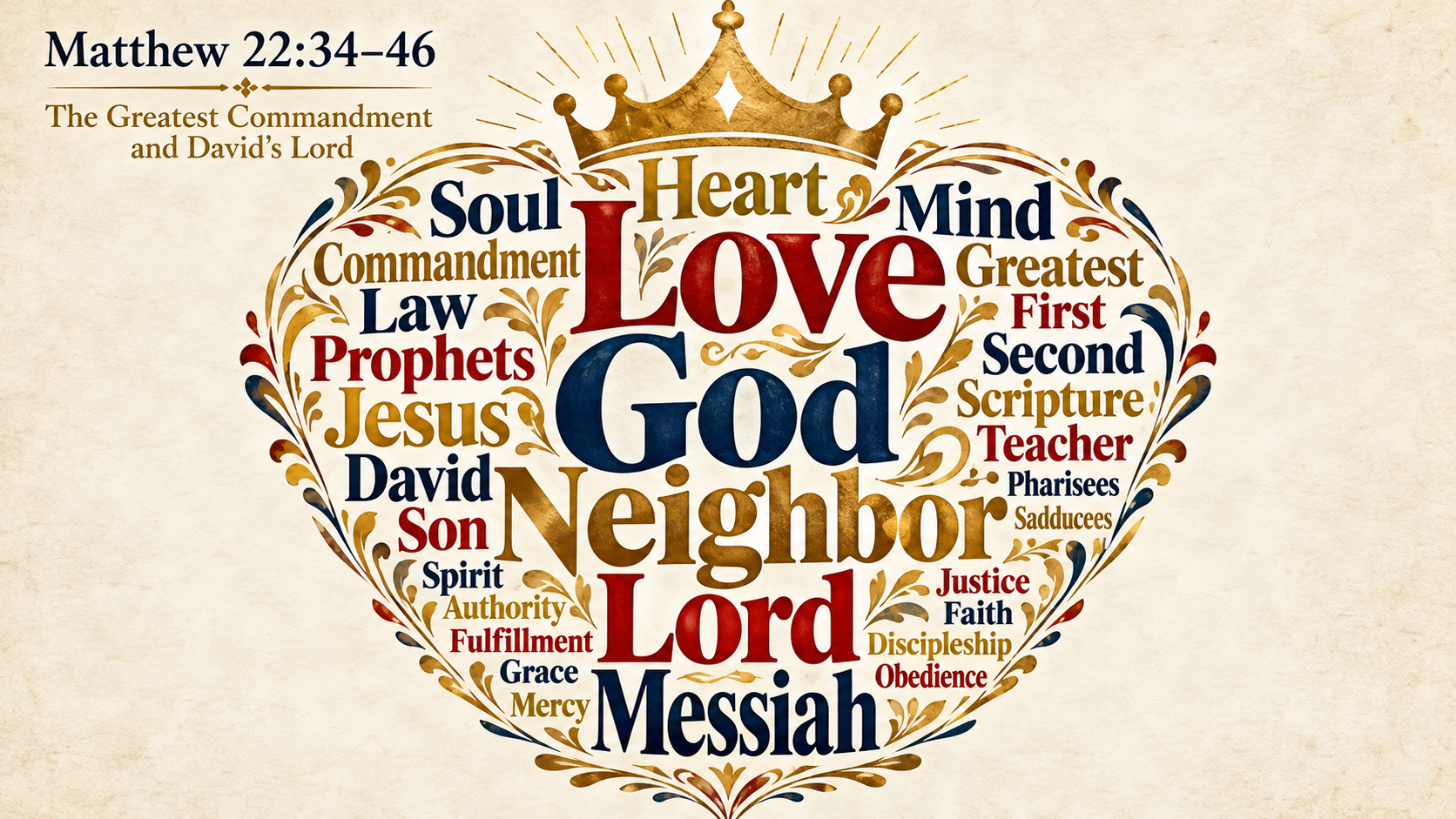
Most Christians know that Jesus commands us to love God and love our neighbors. We hear those words in worship, teach them to children, and recognize them as central to our faith. They sound simple enough until we consider what they require. Loving God means more than attending church or believing the right things. Loving our neighbors means showing compassion even when people disagree with us, disappoint us, or have nothing to offer in return.
In Matthew 22:34–46, Jesus is in Jerusalem during the final week of His earthly ministry. The religious authorities have been questioning Him, hoping to find something they can use against Him. This time, an expert in the Law asks which commandment is greatest. Jesus answers by bringing together two familiar passages from the Old Testament. We are to love God with our whole being and love our neighbors as ourselves. He explains that everything in the Law and the Prophets depends upon these two commandments.
But Jesus does not end the conversation there. He turns to the Pharisees and asks them about the identity of the Messiah. They correctly answer that the Messiah is the Son of David, but Jesus challenges them to recognize that David's promised descendant is also greater than David. The question moves the conversation beyond religious obligations to the identity and authority of Jesus Himself.
These two teachings belong together. The One who commands us to love is also the Savior who demonstrates God's love and makes our transformation possible. None of us has loved God or our neighbors perfectly, but God's grace reaches toward us before we get everything right. Through faith in Christ and the work of the Holy Spirit, we can grow into the love Jesus describes. This passage invites us to examine both what we believe about Jesus and how our relationship with Him is shaping our lives.
Origin and Name
The
Gospel of Matthew appears first in the New Testament, although most scholars
believe Mark was written earlier. Its name comes from Matthew, the tax
collector Jesus called to become one of His disciples. From its opening
genealogy, the Gospel identifies Jesus as the Son of David and the Son of
Abraham, connecting Him to God's covenant promises. Matthew presents Jesus as
the fulfillment of Israel's hope and the One through whom God's blessing
reaches the nations (France).
Authorship
Early
Christian tradition identifies the apostle Matthew as the author, although the
Gospel itself does not name its writer. Many modern scholars believe it was
composed by an educated Jewish Christian who drew upon earlier traditions about
Jesus, including material found in Mark. Whatever its precise origins, the
author's knowledge of Jewish Scripture is evident throughout the Gospel. He
consistently explains Jesus' ministry through God's promises to Israel and
presents Him as the authoritative interpreter of the Law (Keener).
Date and Setting
Many
scholars date Matthew between AD 80 and 90, although some favor an earlier
date. It was probably written for a Christian community with strong Jewish
roots, possibly in Antioch of Syria. These believers were learning to follow
Jesus while navigating tensions with other Jewish communities and adjusting to
changes following the destruction of Jerusalem's Temple in AD 70. Questions
about religious authority, faithfulness to Scripture, and the identity of the
Messiah were especially important in this setting (Hagner).
Purpose and Themes
Matthew
presents Jesus as the promised Messiah who fulfills God's covenant promises and
reveals the kingdom of heaven. The Gospel emphasizes righteousness, mercy,
forgiveness, discipleship, and the authority of Christ. Jesus repeatedly
teaches that genuine faith involves more than outward religious behavior. It
requires a heart turned toward God and a life shaped by His will. This emphasis
is especially clear in the Sermon on the Mount and in Jesus' teaching about the
greatest commandment (Blomberg).
Structure
Matthew
combines accounts of Jesus' ministry with five major teaching sections. These
include the Sermon on the Mount, instructions for the disciples' mission,
parables about the kingdom, teaching about relationships within the community,
and instruction concerning judgment and the future. The final chapters describe
Jesus' arrival in Jerusalem, His confrontations with religious authorities, His
death, and His resurrection. Matthew 22 belongs to the final Jerusalem section,
where questions about Jesus' identity and authority become increasingly urgent
(France).
Significance
Matthew
helps Christians understand the connection between God's promises in the Old
Testament and their fulfillment in Jesus Christ. It also reminds the Church
that discipleship involves both faith in Jesus and obedience to His teaching.
The Gospel concludes with the risen Christ commissioning His followers to make
disciples of all nations. Matthew 22:34–46 brings these themes together by
connecting the greatest commandments with the identity of the Messiah who calls
us to follow Him.
Matthew 22:34–46 is part of a series of confrontations between Jesus and the religious authorities in Jerusalem. Earlier, they questioned His authority, attempted to trap Him with a question about paying taxes to Caesar, and challenged His teaching about the resurrection. Each attempt failed to discredit Him. After Jesus silenced the Sadducees, the Pharisees gathered and sent an expert in the Law to question Him about the greatest commandment. The exchange continues the growing conflict that will eventually lead to His arrest and crucifixion.
Jesus' answer also connects with His earlier teaching. In Matthew 5:17, He explains that He has not come to abolish the Law or the Prophets but to fulfill them. In Matthew 7:12, He teaches that treating others as we want to be treated summarizes the Law and the Prophets. When He identifies love for God and neighbor as the foundation of Scripture, He is reinforcing a message that has been central to His ministry. Genuine righteousness is not simply a matter of outward obedience. It grows from a heart shaped by love (France).
The commandments Jesus quotes come from Deuteronomy 6:5 and Leviticus 19:18. The first belongs to Israel's central confession of faith, the Shema, which calls God's people to love Him completely. The second comes from a chapter that connects holiness with justice, honesty, and compassion. Jesus brings these teachings together to show that devotion to God and responsibility toward others cannot be separated. This same understanding appears in Romans 13:8–10 and 1 John 4:7–21.
The final part of the passage connects with God's promise to David in 2 Samuel 7 and the royal language of Psalm 110. Matthew has already identified Jesus as the Son of David, but Jesus now challenges His listeners to recognize that the Messiah's identity extends beyond human ancestry. The early Church understood Psalm 110 as pointing toward Christ's resurrection and exaltation (Acts 2:34–36). Together, these passages show that the life of love Jesus commands is grounded in the authority and saving work of the Messiah Himself.
John Wesley understood love for God and neighbor as the heart of Christian holiness. For Wesley, salvation was not limited to the forgiveness of sins. God also works through His grace to restore our ability to love Him and one another. This begins with prevenient grace, which reaches toward us before we recognize our need for God. We do not earn God's love through obedience. We respond to the love He has already shown us through Jesus Christ. As Randy Maddox explains, Wesley understood salvation as God's gracious work of restoring humanity to the relationship for which we were created (Maddox).
Justifying grace brings forgiveness and reconciliation with God through faith in Jesus Christ. Sanctifying grace continues working within us, gradually changing our hearts and helping us grow in Christlike love. This understanding is important because Jesus' command to love God completely can seem impossible when we recognize our failures. Wesley taught that Christian perfection does not mean freedom from every mistake or human weakness. It means a heart increasingly governed by love for God and neighbor. The Holy Spirit makes this transformation possible as we continue responding to God's grace (Maddox).
Wesley also insisted that love for God must become visible through love for others. He encouraged Christians to practice both works of piety, such as prayer, worship, searching the Scriptures, and receiving Holy Communion, and works of mercy, such as feeding the hungry, visiting the sick and imprisoned, and caring for people in need. These practices are means through which God nurtures our faith and forms us in love. They are not ways of purchasing salvation. Matthew 22 reminds us that spiritual maturity is measured not simply by what we know about God, but by how His grace is changing the way we live.
Jesus' question about David's Lord adds another important dimension. We do not follow Jesus merely because His teachings are wise or His example is inspiring. We follow Him because He is the Messiah and Lord. His authority gives direction to our discipleship, while His grace gives us the strength to grow. In Wesleyan theology, knowing Christ and becoming more like Christ belong together. Faith receives God's saving grace, and that grace produces a life increasingly characterized by holy love.
Matthew 22:34: The Pharisees Gather
Matthew explains that the Pharisees gathered after hearing that Jesus had silenced the Sadducees. These two groups disagreed on several theological matters, including the resurrection, which the Pharisees affirmed and the Sadducees denied. Although Jesus' answer to the Sadducees supported belief in the resurrection, the Pharisees remained concerned about His authority and influence. Their gathering suggests another deliberate attempt to test Him. The encounter reminds us that agreeing with something Jesus teaches is not necessarily the same as being willing to accept His authority over our lives (France).
Matthew 22:35: An Expert in the Law Tests Jesus
One of the Pharisees, an expert in the Law, approaches Jesus with a question intended to test Him. This man would have been knowledgeable about the Jewish Scriptures and the many commandments governing religious and community life. Jewish teachers regularly discussed how these commandments related to one another and which principles were most important. His question was therefore meaningful, even though Matthew makes clear that his motives were not entirely sincere. Jesus responds seriously despite the man's intentions, showing that truth should not be compromised simply because a question is asked with hostility (Keener).
Matthew 22:36: Which Commandment Is Greatest?
The lawyer asks Jesus which commandment in the Law is the greatest. With so many commandments addressing worship, morality, justice, and daily living, identifying the most important one was a significant theological question. The danger for Jesus was that emphasizing one commandment might be interpreted as diminishing another. Rather than allowing Himself to be drawn into that argument, Jesus identifies the principles that give the commandments their meaning. His answer challenges the tendency to focus so heavily on individual religious requirements that we forget what God desires from His people (Blomberg).
Matthew 22:37: Love God With Your Whole Being
Jesus answers by quoting Deuteronomy 6:5, commanding love for God with all one's heart, soul, and mind. This passage belongs to the Shema, a central confession of Jewish faith that reminded Israel of its covenant relationship with God. The heart, soul, and mind are not intended to divide human beings into separate compartments. Together, they emphasize complete devotion. Loving God involves our desires, decisions, thoughts, priorities, and actions. Jesus is not calling for occasional religious feelings or outward expressions of worship alone. He is describing a relationship with God that shapes every part of life (France).
Matthew 22:38: The First and Greatest Commandment
Jesus identifies love for God as the first and greatest commandment because every other responsibility begins with our relationship with Him. Obedience is not meant to be an attempt to earn God's acceptance but a response to His faithfulness and love. This challenges us to consider what actually holds first place in our lives. Work, family, possessions, and personal security are important, but they can become competing priorities when we allow them to determine our values apart from God. Loving Him first means allowing His character and will to shape how we approach everything else. In Wesleyan terms, such obedience grows from grace rather than becoming a substitute for it (Maddox).
Matthew 22:39: Love Your Neighbor as Yourself
Jesus adds a second commandment from Leviticus 19:18, telling His listeners to love their neighbors as themselves. Leviticus 19 connects this command with justice, honesty, compassion, and concern for vulnerable people. Loving our neighbors therefore involves more than feeling affection toward them. It means treating them with the same dignity, fairness, and concern we naturally desire for ourselves. This love reaches beyond friends and people who share our beliefs. Jesus' teaching in the parable of the Good Samaritan makes clear that genuine neighbor-love crosses social and religious boundaries. Loving someone does not require approving every choice or accepting harmful behavior, but it does require seeking that person's good (Keener).
Matthew 22:40: The Foundation of the Law and the Prophets
Jesus explains that the entire Law and the Prophets depend upon these two commandments. He is not setting aside Scripture or suggesting that the other commandments no longer matter. Instead, He is identifying the love that gives them their purpose. Commands against stealing, lying, violence, and injustice protect people from harm and reflect God's concern for human life. When religious obedience becomes separated from love, it can produce pride, judgment, and indifference toward suffering. Jesus calls His followers to a righteousness that takes God's commandments seriously while remembering that love for God and neighbor stands at their foundation (France).
Matthew 22:41: Jesus Questions the Pharisees
After answering the lawyer's question, Jesus turns the conversation around and asks the gathered Pharisees a question of His own. Until this point, the religious authorities have been questioning Him about His teaching and authority. Now Jesus directs their attention toward the identity of the Messiah. His question is more than an attempt to win a debate. He challenges them to recognize that their understanding of God's promised Savior is incomplete. The conversation moves from what God requires of His people to the identity of the One who has come to fulfill God's promises (Hagner).
Matthew 22:42: Whose Son Is the Messiah?
Jesus asks whose son the Messiah is, and the Pharisees answer that He is the Son of David. Their response reflects God's covenant promise that David's royal line would endure and that a future ruler would come from his descendants. Matthew has already established Jesus' connection to David through the opening genealogy, so the Pharisees' answer is correct. However, Jesus wants them to understand that the Messiah's identity cannot be explained by human ancestry alone. He is greater than the political or national deliverer many expected. This question invites us to consider whether our own understanding of Jesus is limited by what we want Him to be (Keener).
Matthew 22:43: David Calls the Messiah Lord
Jesus asks why David, speaking by the Spirit, refers to the Messiah as Lord. His question introduces Psalm 110, a royal psalm traditionally associated with David. In the ancient world, a respected ancestor normally held greater honor than a descendant, especially when that ancestor was a king. Jesus uses this understanding to challenge the assumption that the Messiah is simply another ruler descended from David. His reference to David speaking by the Spirit also emphasizes the authority of Scripture. The Pharisees know the words of the psalm, but Jesus asks them to consider what those words reveal about the Messiah (France).
Matthew 22:44: The Lord at God's Right Hand
Jesus quotes Psalm 110:1, which describes the Lord inviting David's Lord to sit at His right hand until His enemies are placed beneath His feet. Sitting at a king's right hand represented exceptional honor and authority, while the image of enemies beneath one's feet symbolized victory. Early Christians understood this passage as pointing toward the resurrection and exaltation of Jesus. Peter uses the same psalm in Acts 2:34–36 to explain that the risen Christ has been established as Lord and Messiah. Jesus' authority is therefore greater than that of any earthly ruler. His kingdom is established through God's saving work and will ultimately overcome everything opposed to God's purposes (Hagner).
Matthew 22:45: How Can the Messiah Be David's Son?
Jesus brings His argument to its central question. If David calls the Messiah Lord, how can the Messiah also be David's son? Jesus is not denying His Davidic ancestry. Matthew has already made that connection clear. Instead, He is revealing that the Messiah is greater than His human lineage might suggest. Christian theology understands Jesus as both fully human and fully divine, and this passage contributes to the Gospel's larger presentation of His unique identity. Jesus is the promised descendant of David, but He is also the Lord whose authority exceeds that of David himself. His identity cannot be reduced to the expectations people bring to Him (Blomberg).
Matthew 22:46: No One Dares to Question Him Further
Matthew concludes by explaining that no one could answer Jesus and that no one dared to question Him further. The religious leaders had repeatedly attempted to expose weaknesses in His teaching, but their questions had failed. Jesus' final question leaves them without an adequate response and brings this series of public confrontations to an end. Yet their silence does not necessarily indicate faith. They have been challenged by the truth without showing that they are willing to receive it. The passage reminds us that knowing Scripture and recognizing Jesus as Lord are not always the same thing. Genuine faith calls for more than understanding the right answers. It calls for a response of trust and obedience (France).
One question raised by this passage is whether Jesus' emphasis on love makes the other commandments unnecessary. Jesus has already answered that concern in Matthew 5:17, where He explains that He came to fulfill the Law and the Prophets rather than abolish them. Love does not replace God's commands. It reveals their purpose. Honesty, justice, faithfulness, and respect for human life are practical expressions of love. The commandments help us understand what love looks like when it moves beyond good intentions into daily living (Blomberg).
Another question concerns whether love can genuinely be commanded. We often associate love with emotions, and feelings cannot simply be produced on demand. But biblical love includes commitment, choices, and actions. We can treat someone with kindness even when we feel frustrated. We can seek another person's good even when the relationship is difficult. Wesleyan theology adds that God does not leave us to develop this love through our own strength. His sanctifying grace works within us, gradually changing our desires and helping us become more Christlike (Maddox).
Jesus' question about David's Lord also raises questions about the Messiah's identity. Some readers wonder whether He is denying that the Messiah is David's descendant. Matthew's opening genealogy makes clear that this is not the case. Jesus is challenging an incomplete understanding of the Messiah rather than rejecting His Davidic ancestry. Psalm 110 points toward someone whose authority exceeds that of David himself. While this passage alone does not explain the entire Christian doctrine of the incarnation, it contributes to Matthew's presentation of Jesus as more than an ordinary human king (France).
A final concern involves loving people whose behavior is harmful or whose beliefs contradict our own. Christian love does not require approving wrongdoing, remaining in abusive relationships, or ignoring injustice. Jesus demonstrated compassion while confronting sin and protecting the dignity of those who were vulnerable. Loving another person means seeking that person's genuine good, which sometimes requires accountability, difficult conversations, or healthy boundaries. The command to love our neighbors should never be used to excuse abuse or silence those who have been harmed.
The greatest commandment invites us to examine what holds first place in our lives. Most Christians would readily say they love God, but our priorities do not always reflect that commitment. Work, finances, personal comfort, and even church responsibilities can consume our attention until our relationship with God becomes something we fit into whatever time remains. Loving God with our whole being does not mean abandoning our ordinary responsibilities. It means allowing His presence and teaching to shape how we fulfill them. Our love for God should influence our decisions, conversations, relationships, and the way we respond when life becomes difficult.
Loving our neighbors requires the same kind of intentionality. It is easy to speak about Christian compassion while overlooking the needs of people around us. Our neighbor may be someone struggling financially, an older adult who rarely receives visitors, a family facing illness, or a person whose life has taken a difficult turn. Churches demonstrate God's love through ordinary acts of kindness, whether preparing meals, visiting those who are sick or imprisoned, welcoming newcomers, or helping families in need. These ministries are not simply activities that keep a congregation busy. They are opportunities to make God's grace visible in the community.
The command to love also challenges the way we handle disagreement. Christians will not always share the same opinions about theology, politics, social issues, or church decisions. But disagreement does not give us permission to treat one another with contempt. We can hold firmly to our convictions while listening carefully, speaking respectfully, and remembering that every person bears God's image. Sometimes the clearest demonstration of Christian love is not winning an argument but refusing to let disagreement destroy our compassion. Jesus calls us to reflect His character even when conversations become uncomfortable.
The final verses remind us that our response to Jesus must involve more than admiration. The Pharisees knew the Scriptures, yet they struggled to recognize the Messiah standing before them. We can face a similar danger when faith becomes familiar but stops challenging us. Recognizing Jesus as Lord means allowing His authority to shape our lives. We will not always succeed, but God's grace continues working within us. Each day offers another opportunity to repent, receive His mercy, and grow in love. The question is not simply whether we know the greatest commandments, but whether our lives increasingly reflect the Savior who gave them.
Deuteronomy 6:4–9 establishes the command to love God completely, while Leviticus 19:18 and 19:33–34 connect holiness with love for neighbors and foreigners. Matthew 5:17–20 explains Jesus' relationship to the Law, and Luke 10:25–37 illustrates practical neighbor-love through the Good Samaritan. John 13:34–35, Romans 13:8–10, and 1 John 4:7–21 emphasize that genuine faith becomes visible through love. Second Samuel 7:12–16 establishes God's promise to David, while Psalm 110:1 and Acts 2:34–36 connect that promise to the Messiah's exalted authority.
