
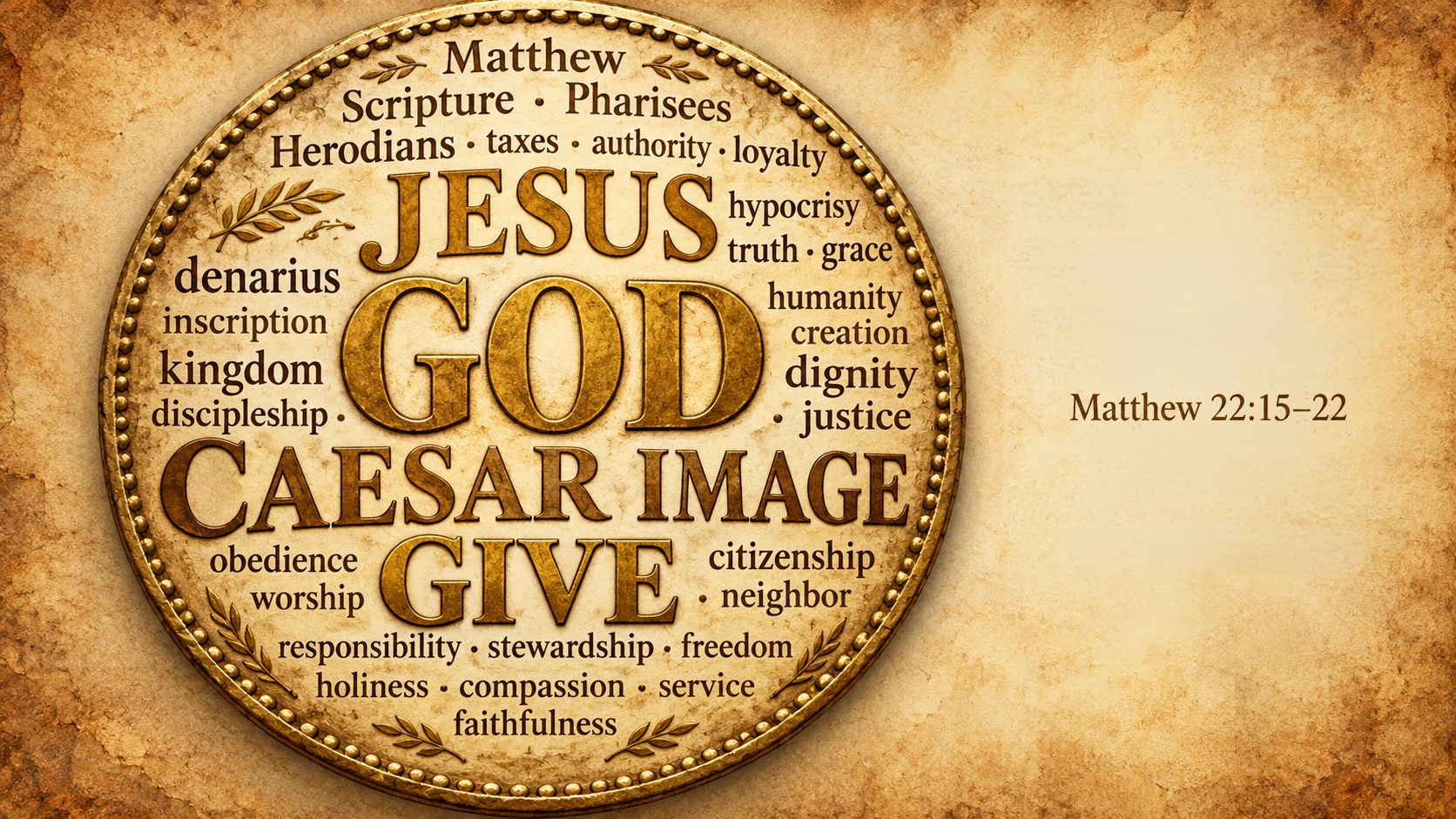
In Matthew 22:15-22, when Jesus tells His opponents to give Caesar what belongs to Caesar and God what belongs to God, He is doing more than answering a question about taxes. He is asking His listeners to consider who has the greatest claim upon their lives.
The conversation takes place during Jesus' final week in Jerusalem. Religious leaders are looking for a way to discredit Him, and they believe a question about Roman taxation will accomplish their purpose. If Jesus supports paying the tax, He risks angering Jewish people who resent Roman occupation. If He opposes it, He could be accused of encouraging rebellion.
Jesus refuses their trap. He asks for a coin bearing Caesar's image and tells them to give Caesar what belongs to Caesar and God what belongs to God. His answer acknowledges legitimate civic responsibilities while establishing that God's authority is greater.
Genesis 1:26–27 teaches that human beings are created in God's image. Although Jesus does not explicitly mention Genesis, the connection suggests an important truth. Caesar's image appears on the coin, but God's image is reflected in humanity. We have responsibilities in this world, but our lives ultimately belong to God (Pape).
Origin and Name
The
Gospel According to Matthew is traditionally associated with Matthew, the tax
collector Jesus called to become His disciple (Matthew 9:9). Although the
Gospel does not identify its author, the early Church connected it with the
apostle. Matthew appears first in the New Testament canon and emphasizes Jesus
as the fulfillment of God's promises to Israel (Attridge and Dinkler).
Authorship
Church
tradition identifies Matthew, also called Levi, as the author. Modern scholars
generally describe the writer as an educated Jewish Christian familiar with
Hebrew Scripture and Jewish religious traditions. Many believe the Gospel draws
upon Mark and other early Christian sources. Regardless of the precise
authorship, Matthew presents Jesus as Israel's Messiah and the authoritative
teacher of God's kingdom (France; Keener).
Date and Setting
Many
scholars date Matthew between A.D. 80 and 90, possibly in Antioch, Syria. If
this dating is correct, its earliest readers were living after Rome destroyed
Jerusalem and the Temple in A.D. 70. Roman authority affected taxation,
religious identity, and everyday life. Jesus' teaching about Caesar would have
spoken directly to communities learning how to remain faithful under Roman rule
(Keener).
Purpose and Themes
Matthew
presents Jesus as the promised Messiah who fulfills Israel's Scriptures and
announces God's kingdom. The Gospel emphasizes discipleship, righteousness,
mercy, forgiveness, and obedience. Jesus repeatedly challenges religious
behavior that looks faithful outwardly but lacks genuine love and justice.
Matthew 22:15–22 continues that concern by exposing the dishonest motives of
religious leaders who claim to defend God's truth.
Structure
Matthew
contains five major teaching sections: the Sermon on the Mount (chapters 5–7),
missionary instructions (chapter 10), kingdom parables (chapter 13), teachings
about Christian community (chapter 18), and teachings concerning judgment and
the future (chapters 23–25). Between these sections, Matthew describes Jesus'
ministry and His journey toward Jerusalem (France).
Significance
Matthew
connects belief in Jesus with the practical responsibilities of discipleship.
Jesus teaches that no one can serve two masters (Matthew 6:24) and calls His
followers to seek God's kingdom first (Matthew 6:33). These teachings help
explain Matthew 22:15–22. Earthly responsibilities matter, but none can replace
our responsibility to God.
Matthew 22:15–22 follows a series of confrontations between Jesus and Jerusalem's religious leaders. After questioning His authority in Matthew 21, they hear parables that expose their resistance to God's kingdom. When they recognize that Jesus is speaking about them, they begin looking for ways to trap Him.
The tax question begins another series of challenges. The Pharisees and Herodians ask about taxation, the Sadducees question the resurrection, and an expert in the Law asks about the greatest commandment. Each encounter concerns Jesus' authority and what faithfulness to God requires.
Matthew 17:24–27 provides an earlier example of Jesus addressing taxation. He instructs Peter to pay the Temple tax rather than create unnecessary offense. Romans 13:1–7 and 1 Peter 2:13–17 likewise encourage respect for governing authorities. However, Acts 5:29 establishes that obedience to God must take priority when human commands conflict with God's will.
Genesis 1:26–27 and Psalm 24:1 provide the larger theological foundation. Humanity bears God's image, and all creation belongs to Him. Government has a legitimate place, but God remains the ultimate authority.
John Wesley understood Christian faith as a relationship with God that transforms the way we live. Genuine holiness includes honesty, generosity, compassion, justice, and responsible participation in society. Our relationship with God should influence every responsibility we carry.
Wesley recognized the trap behind the tax question. Jesus' opponents hoped to make Him appear either disloyal to His people or rebellious against Rome. Jesus avoids both accusations by acknowledging civil obligations while affirming God's greater authority (Wesley).
This understanding fits Wesley's emphasis on social holiness. Faith is personal, but it must become visible in our treatment of others. We cannot claim loyalty to God while ignoring injustice, exploiting vulnerable people, or treating our neighbors dishonestly.
Randy Maddox describes Wesley's theology as responsible grace. God's grace comes first, drawing us toward Christ and making transformation possible. Yet grace invites a willing response. Through sanctifying grace, the Holy Spirit restores God's image within us and shapes our lives toward holy love (Maddox).
Every person bears God's image, including those whose beliefs, circumstances, or choices differ from our own. A Wesleyan reading therefore calls us to responsible citizenship without allowing political identity to replace Christian identity. We belong to God, and our conduct should reflect His love.
Matthew 22:15: The Plan to Trap Jesus
The Pharisees make plans to trap Jesus through His words. Their question is not an honest request for guidance but an attempt to create evidence against Him. The Greek language suggests deliberately ensnaring someone (Nadella).
Their actions reveal the danger of allowing religious authority or personal convictions to become more important than truth. They are so concerned with defeating Jesus that they refuse to consider what He is teaching. We face a similar danger whenever protecting our opinions becomes more important than listening and learning.
Matthew 22:16: An Unlikely Alliance and Carefully Chosen Flattery
The Pharisees send their disciples along with the Herodians, a group associated with the political interests of the Herodian dynasty. Although the groups had different interests, their opposition to Jesus brings them together (Keener).
They begin by praising Jesus as an honest teacher who is not influenced by powerful people. Their statements are accurate, but their intentions are dishonest. They hope to pressure Him into answering their question without hesitation.
Jesus recognizes their manipulation. Their behavior reminds us that truthful words can still be used dishonestly when the intention is to control or harm someone.
Matthew 22:17: The Question About Paying Taxes
The group asks whether it is lawful to pay the imperial tax to Caesar. This was a sensitive question because Roman taxation represented both financial hardship and foreign domination. Taxes also supported the empire responsible for governing Judea (Nadella).
If Jesus approves the tax, He may alienate people who resent Roman rule. If He rejects it, He risks being accused of rebellion. His opponents believe either answer will damage Him.
Their trap depends upon forcing Jesus to choose between two unacceptable outcomes. Jesus demonstrates that wisdom sometimes requires questioning the assumptions behind the choices presented to us.
Matthew 22:18: Jesus Recognizes Their Motives
Jesus recognizes their intentions and calls them hypocrites. Although they present themselves as sincere students, their real purpose is to undermine His authority.
The term "hypocrite" describes the difference between outward appearance and inward reality. Jesus confronts their dishonesty without allowing their hostility to control His response.
This does not mean every difficult question is dishonest. Genuine questions can strengthen faith. Jesus challenges His opponents because they are using religion to disguise manipulation. His response demonstrates that love and truth must remain together.
Matthew 22:19: The Coin Used to Pay the Tax
Jesus asks for the coin used to pay the tax, and His opponents bring Him a denarius. This Roman silver coin carried the emperor's image and inscriptions expressing imperial authority.
Coins issued under Tiberius could identify him as the son of the divine Augustus and associate him with the title of high priest. Such claims created religious concerns for Jewish people who believed that the Lord alone was God (Pape).
By producing the coin, Jesus' opponents demonstrate that they already participate in Rome's economic system. Jesus does not condemn them for possessing it. Instead, He uses the coin to teach them about the difference between earthly obligations and divine authority.
Matthew 22:20: Whose Image and Inscription?
Jesus asks whose image and inscription appear on the coin. The Greek word eikōn, meaning image or likeness, also appears in the Greek translation of Genesis 1:26–27.
Although Matthew does not explicitly connect the passages, the shared language invites us to consider the difference between Caesar's image on currency and God's image in humanity (Pape).
A coin receives its image through human manufacturing. People receive their dignity through creation. Our worth does not depend upon wealth, social standing, physical ability, or religious achievement. Every human being bears God's image and is loved by the Creator.
Matthew 22:21: Give to Caesar and Give to God
Jesus tells His opponents to give Caesar what belongs to Caesar and God what belongs to God. The Greek verb carries the sense of returning or paying what is owed. Jesus acknowledges legitimate civic responsibilities without suggesting that government possesses unlimited authority.
The second part of His answer establishes the greater claim. Psalm 24:1 declares that everything belongs to God. Caesar himself is part of God's creation and remains subject to divine authority.
Wesley recognizes that Jesus' response addresses both groups. The Pharisees are reminded of their civic responsibilities, while the Herodians are reminded of their responsibility to God (Wesley).
The image on the coin also points toward the image of God in humanity. Caesar may claim the currency bearing his likeness, but our lives belong to the Creator (Pape).
For Christians, this means that paying taxes, working honestly, caring for family, and serving our communities can become expressions of faithfulness. Yet none of these responsibilities can replace our ultimate loyalty to God.
Matthew 22:22: Amazed and Silenced
Jesus' opponents are amazed by His answer and leave Him. They expected a response they could use against Him, but Jesus has exposed the limitations of their question.
There is something troubling about their reaction. Matthew tells us they are amazed, but he does not say they repent or become disciples. They recognize His wisdom without showing evidence that His teaching has changed them.
We can make the same mistake. It is possible to admire Jesus, appreciate His teaching, and still resist His authority over our lives. The passage invites us to do more than agree with His words. It calls us to live as people who belong to God.
Does Jesus Mean Christians Must Always Obey the Government?
Jesus acknowledges legitimate civil responsibilities, but He does not require unquestioning obedience to government. Scripture provides examples of faithful resistance when human commands violate God's will.
The Hebrew midwives refuse Pharaoh's orders in Exodus 1:15–21. Daniel continues praying despite a royal prohibition in Daniel 6. The apostles insist upon obeying God rather than human authorities in Acts 5:29.
Christians should ordinarily fulfill their civic responsibilities, but their ultimate obedience belongs to God.
Is Jesus Separating Religion from Politics?
Some interpret this passage as separating public life from religious faith, with Caesar controlling political matters and God controlling worship. However, Scripture does not limit God's authority to religious activities.
Psalm 24:1 declares that everything belongs to God, and Matthew 6:33 calls believers to seek His kingdom first.
Our faith should therefore influence our decisions about money, business, leadership, politics, and relationships. This does not require Christians to agree on every public issue, but it does require our decisions and behavior to reflect Christ's teaching.
Does the Image of God Connection Read Too Much into the Passage?
Jesus does not explicitly connect Caesar's image with Genesis 1:26–27. Therefore, we should recognize the connection as a theological interpretation rather than something Matthew directly explains.
However, the Greek word eikōn appears in both passages, and Matthew frequently draws upon Old Testament themes. The connection is consistent with Scripture's teaching that humanity belongs to God (France; Pape).
Whether or not Jesus intended the connection, His answer establishes that God's authority is greater than Caesar's.
Does Giving Everything to God Mean We Have No Personal Freedom?
Wesleyan theology teaches that God's grace enables a genuine human response. Through prevenient grace, God draws us toward Himself and makes faith possible, but He does not force us into a relationship (Maddox).
Christian freedom is not simply doing whatever we desire. It includes being freed from sin's power so that we can love God and others more fully.
God desires our willing trust and devotion. His claim upon our lives comes from the love of the Creator who gave Himself for our salvation.
Examining Our Loyalties
Most Christians would say that God comes first, but our decisions do not always reflect that belief. Comfort, financial security, reputation, and political convictions can gradually become more important than following Jesus.
These concerns are not necessarily wrong. The problem comes when they begin directing our lives more than God's teaching. We can examine our loyalties by considering whether our choices reflect Christ's compassion, honesty, generosity, and love.
Practicing Responsible Citizenship
Jesus does not encourage His followers to withdraw from society. Honest work, paying legitimate taxes, participating in community life, and caring for neighbors can all express Christian discipleship.
Responsible citizenship also requires recognizing injustice and speaking against harmful practices. We can respect legitimate authority while remembering that our responsibility to God comes first. Our convictions should influence our decisions, but Christ's love should guide how we treat those who disagree with us.
Remembering Whose Image Others Bear
Every person we encounter bears God's image. That includes the people we disagree with, those whose choices we do not understand, and those whom society often overlooks.
Recognizing God's image in others does not mean approving everything they do. It means treating them with dignity even when correction or accountability is necessary.
The person in jail, the family struggling financially, and the stranger entering church for the first time all matter to God. Our words and actions should reflect that truth.
Offering God Our Whole Lives
Giving God what belongs to Him means allowing our faith to shape everyday life. Our relationship with Christ should influence our finances, conversations, responsibilities, decisions, and relationships.
Sometimes that requires admitting we were wrong, forgiving someone, making a difficult choice, or surrendering something we have been afraid to place in God's hands.
Thankfully, God does not abandon us when our loyalties become confused. His grace continues calling us back. The same Jesus who teaches us to give God what belongs to God gives His own life for people who have repeatedly failed to do so.
We belong to God, and His love makes it possible for us to live more faithfully as His children.
Genesis 1:26–27: Created in God's Image. Humanity receives dignity and worth through creation. This provides an important theological connection with Caesar's image on the coin.
Psalm 24:1: Everything Belongs to God. The whole earth belongs to the Lord, establishing the limits of every earthly claim to authority.
Matthew 6:24: No One Can Serve Two Masters. Jesus warns about competing loyalties and the danger of allowing earthly concerns to take God's place.
Matthew 6:33: Seek First God's Kingdom. God's kingdom must remain the guiding priority of Christian life.
Matthew 17:24–27: Jesus and the Temple Tax. Jesus acknowledges practical responsibilities while teaching about freedom and obligation.
Romans 13:1–7: Responsibilities Toward Governing Authorities. Christians should respect legitimate authority and fulfill appropriate civic responsibilities.
Acts 5:27–29: Obeying God Above Human Authority. Obedience to God takes priority when human commands conflict with His will.
1 Peter 2:13–17: Respecting Authority While Honoring God. Believers are called to respect others while maintaining their highest loyalty to God.
Romans 12:1–2: Offering Our Whole Lives to God. Christian discipleship involves offering ourselves to God and allowing Him to transform our thinking and behavior.
Colossians 3:10: Renewed in the Creator's Image. God's transforming grace restores our ability to reflect His character.
