
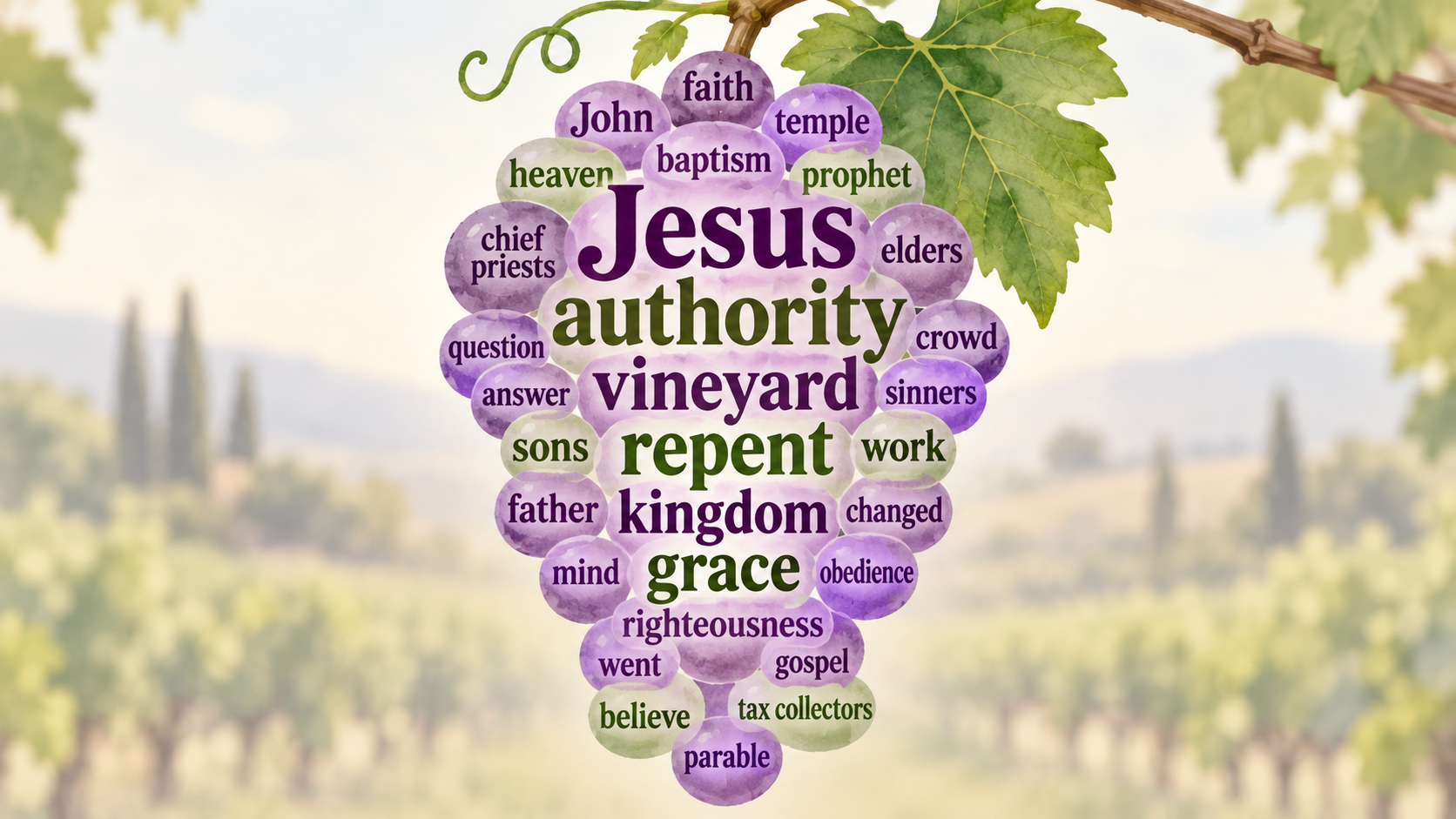
Matthew 21:23–32 takes place in the tension-filled days between Jesus’ triumphal entry into Jerusalem and His crucifixion. Jesus has entered the city to shouts of “Hosanna,” cleansed the temple, healed people within its courts, and challenged the religious system that had grown comfortable with its own authority. By the time He returns to the temple in verse 23, the religious leaders are no longer merely watching Him. They are confronting Him.
Their question sounds reasonable: “By what authority are you doing these things? And who gave you this authority?” Yet the setting makes clear that this is not simply a request for information. They are challenging Jesus’ right to act as He has acted. He has entered their territory, confronted practices they have allowed, taught the people, and behaved as though He possesses authority that does not depend upon their approval.
Jesus responds with a question about John the Baptist. His answer exposes a deeper issue. The leaders’ problem is not that God has failed to give them enough evidence. Their problem is that accepting the evidence would require them to change.
Jesus then tells the brief parable of two sons. One son refuses his father and later goes to work. The other speaks respectfully and promises obedience but never follows through. Jesus uses the story to confront people who know the language of faith but have resisted the God to whom that language points.
The passage is not simply about hypocrisy, and it should not be reduced to a warning against saying one thing and doing another. At its heart, Matthew 21:23–32 is about our response to God’s gracious call. Jesus makes room for repentance. A person who has said no to God can still turn around. A broken past is not a locked door. At the same time, religious language cannot substitute for obedience. God desires more than the appearance of faithfulness. He desires hearts that respond to grace.
The surprising announcement that tax collectors and prostitutes are entering the kingdom ahead of respected religious leaders brings the point home. Those who appeared farthest from God had heard John’s message, believed it, and changed direction. Those who looked closest to God saw that transformation and still refused to reconsider their own lives.
Grace reaches those who have said no. Grace also calls those who have learned to say all the right things to examine whether their lives truly answer yes.
Origin and Name
The Gospel takes its name from Matthew, also known as Levi, a tax collector
who became one of Jesus’ twelve disciples. That matters because Matthew’s own
calling reflects one of the Gospel’s central convictions: Jesus brings grace to
people others have written off. A tax collector becoming a disciple and witness
fits the larger story of a Messiah who calls sinners, heals outsiders, and
forms a new people by mercy (France).
Authorship
Early Christian tradition connects this Gospel with Matthew the apostle. The
Gospel itself does not name its author, but it shows deep knowledge of Jewish
Scripture, careful theological structure, and concern for the life and teaching
of the Church. It presents Jesus as the fulfillment of Israel’s story and the
authoritative teacher of God’s people (Keener).
Date and Setting
Matthew was likely written between AD 70 and 90, after the destruction of
the Jerusalem temple. Jewish and Christian communities were wrestling with
identity, authority, worship, and faithfulness in a changed world. Matthew
speaks into that setting by showing that Jesus is not a break from God’s
promises to Israel but their fulfillment (Davies and Allison).
Purpose and Themes
Matthew presents Jesus as Messiah, Son of David, Son of Abraham, Son of God,
and Immanuel. Major themes include fulfillment of Scripture, the kingdom of
heaven, righteousness shaped by mercy, discipleship, judgment, mission, and the
presence of Christ with His people. Matthew never separates grace from
obedience. Jesus calls people into mercy, forgiveness, transformation, and
faithful living.
Structure
Matthew weaves narrative and teaching together. The Gospel includes five
major teaching sections, often seen as echoing the five books of Moses. Jesus
appears as the greater teacher who fulfills and rightly interprets God’s will.
The Gospel moves from Jesus’ birth and identity, through His ministry and
teaching, into His suffering, death, resurrection, and final commissioning of
the disciples.
Significance
Matthew begins by identifying Jesus as Emmanuel and ends with His promise to remain with His followers always. Matthew 16:13–20 stands near the center of that story. The disciples are beginning to name clearly the One they’ve been following, but they still have to learn that His kingdom won’t look like the kingdoms around them.
France’s commentary gives particular attention to Matthew’s own literary and theological presentation of Jesus within the first-century setting. Keener likewise emphasizes the Gospel’s social setting and its call to discipleship.
Matthew 21 begins with Jesus entering Jerusalem in a way that intentionally recalls Zechariah’s vision of the humble king coming to Zion. The crowd welcomes Him with language drawn from Psalm 118. Jesus then enters the temple, overturns the tables of those buying and selling, and declares that God’s house should be a house of prayer.
That action provides the immediate background for the question in verse 23. When the chief priests and elders ask, “By what authority are you doing these things?” the “things” likely include Jesus’ cleansing of the temple, His teaching, His healing ministry, and His public actions since entering Jerusalem (France).
The passage also connects directly to John the Baptist. John had appeared at the beginning of Jesus’ public ministry declaring, “Repent, for the kingdom of heaven has come near” in Matthew 3:2. Jesus begins His own preaching with the same announcement in Matthew 4:17. John and Jesus are therefore closely connected in Matthew’s account of the kingdom.
John called Israel to repentance. Some responded. Others, especially among the religious establishment, refused his message. Jesus now forces the leaders to face what their response to John reveals about their response to God.
This pattern runs throughout Scripture. God sends messengers. Human beings must decide whether they will listen. Israel’s prophets repeatedly confronted people who maintained religious practices while resisting God’s call to justice, mercy, faithfulness, and repentance. Isaiah, Jeremiah, Amos, Hosea, and Micah all challenged the assumption that worship alone could substitute for obedience.
Jesus stands within that prophetic tradition while also surpassing it. He is not simply another messenger asking people to return to God. Matthew presents Him as the Son whose authority comes from God and whose arrival brings the kingdom near.
The parable of the two sons also reflects a pattern found throughout the biblical story. God often works through people whom conventional religious judgment has dismissed. Rahab, Ruth, David, Zacchaeus, the Samaritan woman, and others remind us that God’s grace is not restricted by the labels people place upon one another.
The kingdom of God is not populated by people who have never said no. It is populated by people who, by grace, finally turn toward God.
A Wesleyan reading of Matthew 21:23–32 naturally draws our attention to grace, repentance, response, and the way faith is lived out. John Wesley never understood salvation as simply being forgiven so that we could avoid the consequences of sin. Salvation is God’s work of restoring us, shaping us, and teaching us to love God and our neighbors more fully. Grace reaches us before we deserve it, before we understand it, and often before we even realize that God is at work. It awakens us to our need for Him, makes repentance possible, brings forgiveness and new life through Christ, and continues changing us as we grow in holiness.
The first son in Jesus’ parable gives us a simple picture of that kind of grace. His first answer is no. He does not want to go into the vineyard, and he says so plainly. Yet the story does not end with his refusal. He changes his mind, turns around, and goes to do what his father asked. His first answer matters, but it does not have the final word. That is one of the most hopeful truths in this passage. Grace means that our first answer to God does not have to be our final answer.
Wesleyan theology holds together two truths that are both important. God acts first, and we are called to respond. Randy Maddox describes Wesley’s understanding as “responsible grace.” God does not wait for us to become worthy before reaching toward us. He is already at work, drawing, inviting, convicting, and enabling us to respond. At the same time, grace does not force us. We can receive it, resist it, or ignore it. The first son shows what it looks like to respond when grace opens the door for a different choice.
That helps us understand repentance in a healthier way. Repentance is not something we do in order to earn God’s love. It is a response to the love and grace that have already come looking for us. Sometimes Christians have spoken about repentance mostly in terms of guilt and shame, but biblical repentance is larger than that. It is a change of direction. It is recognizing that we have been walking the wrong way and allowing God to turn us toward Him. The first son cannot undo his original refusal, but he can still choose what he does next. So can we.
The religious leaders show us the opposite danger. They know the language of faith. They hold respected positions. They probably see themselves as the faithful ones in the story. Yet when God speaks through John the Baptist, they refuse to respond. Even when they see tax collectors and prostitutes believing John and changing direction, they remain where they are. Their problem is not that they lack religious knowledge. Their problem is that they are unwilling to let what God is doing change them.
Wesley often warned about having the “form of godliness” without its power. Religious practices matter. Prayer, worship, Scripture, Holy Communion, fasting, fellowship, and acts of mercy are all important means of grace. They are ways God meets us, strengthens us, and forms us. But they can become empty if we begin to treat them as proof that we are already where God wants us to be. The purpose of the means of grace is not simply to make us look faithful. Their purpose is to keep opening our lives to the transforming work of God.
That is why this passage speaks to both the openly rebellious and the comfortably religious. To those who have said no to God, Jesus offers hope. It is not too late to turn around. To those who have said yes with their words for years, Jesus offers a warning. Saying the right things cannot take the place of actually following where God leads. Faith is not only what we confess. It is also what our lives become.
Prevenient grace means that the Father keeps calling even after we have said no. Justifying grace means that when we turn to Christ in faith, we are forgiven, reconciled, and welcomed. Sanctifying grace means that God keeps working in us so that our lives begin to reflect more and more of the love of Christ. Our yes to God is meant to become visible in the way we forgive, serve, show mercy, love our neighbors, and follow Jesus.
The question in this passage, then, is not simply whether we have ever said yes to God. The deeper question is whether our lives are still being shaped by that yes. And when we discover places where they are not, grace is still there, calling us to change direction and walk into the vineyard.
Matthew 21:23: “Jesus entered the temple courts”
Jesus returns to the temple after the events of the previous day, and Matthew deliberately places this confrontation within the very center of Israel’s religious life. The temple represented worship, sacrifice, priestly service, Scripture, national identity, and the presence of God among His people. Jesus is not discussing abstract theology in a private setting. He is publicly teaching in a place where questions of religious authority carry enormous weight. After entering Jerusalem as king, overturning the tables of the money changers, healing the blind and lame, and receiving the praise of children, Jesus now returns to teach.
The chief priests and elders approach Him while He is teaching. These are not uninformed observers. They represent recognized religious leadership, and at one level their concern is understandable. Those entrusted with spiritual leadership have a responsibility to discern whether someone claiming religious authority should be trusted. Scripture itself warns against false prophets and false teachers. Yet Matthew has already given the reader abundant evidence about Jesus. The issue is no longer simply whether authority should be examined. The deeper question is what happens when protecting our own authority becomes more important than recognizing the authority of God.
Matthew 21:23: “By what authority are you doing these things?”
The Greek word translated “authority,” *exousia*, refers to the right, freedom, or legitimate power to act. The leaders are essentially asking Jesus, “Who gave You the right to do this?” Their concern likely includes not only His present teaching but everything He has recently done in Jerusalem, especially His actions in the temple. They want to know what gives Him the right to challenge established practices, teach publicly, heal, and behave as though He possesses authority over the sacred space itself.
The irony is strong because Matthew has been demonstrating Jesus’ authority throughout the Gospel. Jesus teaches with authority in Matthew 7:29. He claims authority to forgive sins in Matthew 9:6. He gives His disciples authority over unclean spirits and disease in Matthew 10:1. He demonstrates authority over sickness, demons, nature, Sabbath interpretation, and traditional understandings of purity. The leaders are looking for institutional credentials while Matthew has been showing divine credentials. Their second question makes their concern even clearer: “Who gave you this authority?” Someone must have authorized Him, they assume, and in that assumption they are correct. The real issue is whether they are prepared to accept the answer.
Matthew 21:24: “I will also ask you one question”
Jesus does not avoid their challenge. Instead, He responds with another question that exposes the deeper issue beneath their demand. Answering a question with another question was not unusual in Jewish teaching and debate, especially when the second question clarified assumptions behind the first. Jesus is not trying to escape the conversation. He is testing whether these leaders are genuinely willing to recognize divine authority when it appears before them.
If they can honestly identify the source of John the Baptist’s ministry, they already have the framework necessary for understanding Jesus. John did not operate independently of Jesus’ mission. He prepared the way for Him, announced the coming kingdom, called Israel to repentance, baptized Jesus, and bore witness to His significance. The question about John therefore becomes a question about whether the leaders are willing to acknowledge what God has been doing among them.
Matthew 21:25: “John’s baptism, where did it come from?”
Jesus asks whether John’s baptism came “from heaven” or “from human origin.” “From heaven” was a reverent Jewish way of referring to God, so the question is straightforward: Was John sent by God, or was his ministry simply something he devised for himself? The form of the question is simple, but the implications are dangerous for the leaders.
John’s ministry had been public and unmistakable. Crowds came to hear him. He called people to repentance, warned against relying on religious ancestry, and demanded fruit consistent with changed lives. He also prepared the way for Jesus. If the leaders admit that John’s authority came from God, they must face the fact that they ignored a prophet whom God sent. If John truly spoke for God, then his message and his witness concerning Jesus cannot simply be dismissed.
Matthew 21:25–26: “They discussed it among themselves”
The leaders’ private discussion reveals more than the answer they eventually give. What is most striking is what they do not ask. They do not ask, “What is true?” Instead, they calculate which answer will create the least difficulty for them. If they acknowledge that John’s authority came from heaven, Jesus will ask why they did not believe him. If they claim that John’s authority was merely human, they fear the reaction of the crowd because the people regard John as a prophet.
Their reasoning has become political rather than theological. They are not discerning truth. They are managing consequences. This is one of the uncomfortable warnings in the passage because religious people can become very skilled at discussing God while making decisions based primarily on reputation, influence, comfort, or self-protection. The leaders are trapped not because Jesus has treated them unfairly but because they are unwilling to answer honestly.
Matthew 21:27: “We don’t know”
Their answer is cautious, but it is also revealing. They claim ignorance because neither truthful answer is convenient. Jesus responds, “Neither will I tell you by what authority I am doing these things.” He is not saying that the source of His authority can never be known. Matthew has been revealing the answer throughout the Gospel. Jesus is exposing the fact that additional information will not help people who are unwilling to follow the evidence they already have.
There is an important difference between honest doubt and chosen blindness. Scripture gives plenty of room for questions, uncertainty, wrestling, lament, and the struggle to understand. The leaders are doing something different. They understand the implications of the evidence but refuse to follow where it leads because doing so might require them to change. Their problem is not simply lack of information. It is resistance.
Matthew 21:28: “What do you think?”
Jesus now tells a parable, beginning with the invitation, “What do you think?” The phrase matters because Jesus allows His opponents to judge the situation for themselves. Like Nathan confronting David with the story of the rich man who stole the poor man’s lamb in 2 Samuel 12, Jesus lets His listeners recognize the truth before they realize how directly it applies to them.
“A man had two sons.” The setting is simple and familiar. Both sons belong to the same father, and both receive the same command. The important difference is not who the father loves or which son belongs in the family. Both are sons. The difference will be seen in how they respond to the father’s will.
Matthew 21:28: “Son, go and work today in the vineyard”
The father’s request is direct: “Son, go and work today in the vineyard.” Vineyard imagery would have been familiar to Jesus’ listeners because Scripture often uses the vineyard as an image for Israel and God’s people, most notably in Isaiah 5. Jesus does not necessarily intend every detail of this short parable to function as an allegory, but the vineyard setting fits naturally within the larger biblical story of God calling His people to faithful service.
The father does not ask his son merely to agree that vineyards are important or to speak positively about the work. He tells him to go and work. That distinction is central to Jesus’ point. Throughout Matthew, faith cannot be reduced to speaking correct words while remaining unmoved. The kingdom calls for response. What we say matters, but our words are meant to take shape in the way we live.
Matthew 21:29: “I will not”
The first son’s response is shockingly direct. He refuses. There is no attempt to hide the rebellion behind respectful language or offer an excuse. He simply says no. Yet Jesus does something beautiful with this son. He does not freeze him forever at the moment of his worst answer. The son who says no is not condemned to keep saying no.
That is one of the clearest pictures of grace in the passage. We sometimes allow a person’s worst choices, past failures, or most painful words to become permanent descriptions of who we believe that person is. Jesus does not. The first son begins in rebellion, but rebellion does not have to be the end of his story. Grace leaves room for another answer.
Matthew 21:29: “Later he changed his mind and went”
Later, the son changes his mind and goes into the vineyard. The Greek verb used here carries the idea of reconsidering, regretting, or experiencing a change of mind. What makes the change significant is that it leads to action. The son does not merely feel guilty about what he said. He gets up and goes.
This helps us understand biblical repentance. Repentance may involve sorrow and regret, but it is larger than emotion. Regret says, “I wish I had not done that.” Repentance says, “By God’s grace, I am going another way.” The change becomes visible through a different direction. This is why the tax collectors and prostitutes become such important examples later in the passage. Their response to John was not merely emotional. Something about the direction of their lives changed.
The first son reminds us that our past refusal does not have to determine our future response. We cannot always undo what we have done or unsay what we have said, but by God’s grace we can choose what we do next.
Matthew 21:30: “Then the father went to the other son”
The father gives the same command to the second son, who responds, “I will, sir.” His answer sounds respectful and obedient. The word translated “sir” can also mean “lord,” which adds another layer of irony to the story. This son knows exactly what an obedient child is supposed to say. His words sound right, but he does not go.
The contrast is now complete. One son has bad words followed by obedience. The other has good words followed by disobedience. Jesus is not suggesting that words are unimportant or that disrespect is acceptable. He is showing that correct words without faithful action are not obedience. Saying yes to the father means very little if the son never enters the vineyard.
Matthew 21:31: “Which of the two did what his father wanted?”
Jesus now asks the question whose answer seems obvious: “Which of the two did what his father wanted?” The leaders answer, “The first.” In doing so, they unknowingly pronounce judgment upon themselves. They are perfectly capable of recognizing obedience when they encounter it in a story. What they struggle to recognize is how the same truth applies to their own relationship with God.
Jesus is not claiming that words do not matter. Confession, testimony, teaching, worship, and promises all depend upon words. The issue is whether our words correspond to the way we actually live. Matthew has already made this point in Jesus’ warning that not everyone who says, “Lord, Lord,” enters the kingdom of heaven, but the one who does the will of the Father (Matthew 7:21). The second son knows the language of obedience. The first son eventually does the father’s will.
Matthew 21:31: “The tax collectors and the prostitutes are entering the kingdom of God ahead of you”
Jesus’ application of the parable would have been startling. Tax collectors were widely despised because of their association with Roman taxation and because the system offered opportunities for exploitation. Prostitutes represented another group regarded as morally compromised and socially shameful. Jesus deliberately chooses people whom respectable religious society would have placed near the bottom of the moral ladder.
Yet He says they are entering the kingdom of God ahead of the chief priests and elders. Jesus is not saying that exploitation, sexual sin, or any other sin is acceptable. The entire point depends upon repentance. These are people who heard John’s call, believed, and changed direction. Those who appeared farthest from God were responding to Him, while those who appeared closest were refusing His call.
That distinction matters because Christian grace never requires us to pretend sin does not matter. Grace means that sin does not get the final word. A person’s past does not place them beyond God’s reach when they respond to His call.
The phrase “ahead of you” is also important. Jesus does not necessarily describe the leaders as permanently excluded at this moment. Others are going ahead because they have responded, but the language still leaves room for the leaders to follow. Even within this severe confrontation there is grace. Jesus is still calling them to become like the first son, to reconsider and go.
Matthew 21:32: “For John came to you to show you the way of righteousness”
Jesus now explains the connection between the parable and the leaders’ response to John. John came “in the way of righteousness,” calling people back to faithful relationship with God. He did not come with the social position or institutional prestige of the chief priests and elders. He came from the wilderness preaching repentance and announcing that the kingdom of heaven had drawn near.
John’s authority was not rooted in status. It was visible through his faithfulness to the task God had given him. His life and message pointed toward God, and people responded. Yet the religious leaders did not believe him. Once again, the issue is not that God failed to speak clearly enough. The issue is that they were unwilling to receive the message when it came through someone outside the structures they expected.
Matthew 21:32: “And you did not believe him”
Here Jesus connects the religious leaders directly with the second son. They know the language of obedience and occupy positions that suggest devotion to God, but when God actually calls them to respond, they refuse. They can say yes to God in principle while saying no to what God is doing in front of them.
This is one of the dangers of religious familiarity. We can become so accustomed to talking about God that we stop expecting God to challenge us. We can know Scripture and still resist what Scripture asks of us. We can attend worship faithfully while protecting certain areas of our lives from God’s influence. We can defend Christianity while refusing to follow Christ into forgiveness, humility, mercy, generosity, reconciliation, or costly love.
The problem is not religious practice. Jesus is not condemning worship, Scripture, leadership, or spiritual discipline. The problem is religion that has stopped listening. The danger comes when our familiarity with the things of God convinces us that we no longer need God to change us.
Matthew 21:32: “But the tax collectors and the prostitutes did”
Those assumed to be farthest from God believed John. This fits a pattern that runs throughout Matthew’s Gospel. Again and again, people with little social standing recognize what others overlook. Gentiles demonstrate surprising faith. Children are welcomed. The sick and unclean come near. Sinners find themselves sitting at the table with Jesus.
God’s kingdom repeatedly disrupts the rankings people create. Respectability does not earn a place in the kingdom, and a broken past does not automatically exclude someone from it. Everyone comes through grace. The tax collectors and prostitutes are not examples because they have somehow earned God’s favor through a better moral record. They are examples because they recognize their need and respond when grace calls.
That is both a warning and a comfort. It warns the religiously comfortable against assuming that familiarity with God is the same thing as faithfulness to God. It comforts anyone who fears that the mistakes of the past have placed them outside God’s reach. When grace calls, there is still a road home.
Matthew 21:32: “Even after you saw this, you did not repent and believe him”
This may be the sharpest part of the entire passage. The leaders had more than John’s preaching. They had the evidence of changed lives. They watched people whom society had dismissed respond to God. They saw tax collectors and prostitutes repent. They saw people who had been moving away from God begin turning toward Him. Yet even after seeing what grace was doing, they remained unmoved.
The same verb used when the first son “changed his mind” appears again here. The first son reconsidered and went. The leaders saw God at work and still would not reconsider. Their problem is therefore not simply that they made the wrong judgment about John at the beginning. Their deeper problem is that they continued defending that judgment even when confronted with evidence that God was doing something they had failed to recognize.
There is an important warning here for the Church. Sometimes God’s work appears in people we did not expect, through ministries we did not plan, or among communities we have overlooked. Sometimes the people we assumed were far away begin responding to grace before those of us who have spent years inside the Church recognize what God is doing. When lives are being healed, sinners are finding grace, the excluded are discovering belonging, and people are turning toward Jesus, our first response should not be to defend our territory or protect our assumptions.
We should rejoice that God is at work.
The leaders’ failure was not that they had once been wrong. The first son had been wrong too. Their failure was their unwillingness to change when God gave them another opportunity. That is what makes this passage both challenging and deeply hopeful. Jesus does not demand that we have always gotten everything right. He calls us to remain open enough to grace that when we discover we have been wrong, we can change our minds, change our direction, and follow where God is leading.
This passage raises the question of why Jesus does not answer the religious leaders directly. Some people might think He is avoiding a fair question about His authority. At first glance, their question seems reasonable. After all, religious leaders should care about where spiritual authority comes from, especially when someone is teaching in the temple and challenging traditions. But when we look at the bigger picture, it becomes clear that Jesus is not talking to people who just need more information.
All through Matthew, Jesus has already shown plenty of evidence for His authority. He teaches in a way that is different from the scribes, forgives sins, heals people, casts out demons, controls nature, fulfills Scripture, and announces God’s kingdom. His actions show that His authority is more than just human. But the real issue comes out in how the leaders talk about John the Baptist. They are not really looking for the truth. Instead, they are trying to find the answer that will cause them the least trouble. Their worry about the crowd’s reaction shows that they are more interested in protecting themselves than in truly understanding what God is doing.
So Jesus responds to the real issue behind their question. Before they can understand where His authority comes from, they need to be open to recognizing God’s authority when it is right in front of them. Their rejection of John is important because John prepared the way for Jesus. If they will not accept what God did through John, then just giving them another explanation will not help. Their problem is not that they lack evidence. It is that they are not willing to respond honestly to the evidence they already have.
Another challenge in this passage is Jesus’ statement that tax collectors and prostitutes are entering God’s kingdom before the chief priests and elders. Out of context, it might seem like Jesus is rejecting good people and favoring those with obvious sins. But that is not what He means. Jesus is not praising wrongdoing or sinful behavior. Instead, He is making a point about repentance and how people respond to grace.
The tax collectors and prostitutes Jesus talks about listened to John’s call to repent. They heard his message, saw their need, and changed their lives. The religious leaders, on the other hand, looked righteous and had the respect of others, but they refused to respond to the same call. Jesus is warning against thinking that looking good on the outside can replace a heart that is open to being changed by God.
This is one of the gospel’s most important truths. The religious leaders’ good reputation does not save them, and the past sins of tax collectors and prostitutes do not keep them from being saved. Everyone needs grace. Everyone is called to repent. No one enters God’s kingdom because of a perfect record, religious background, family, or reputation. We come because God calls us with grace, and we respond to that grace with faith.
This passage brings together both judgment and hope. It challenges people who think they do not need to repent, but it also gives great hope to those who worry that their past keeps them from God’s mercy. Jesus does not let religious success or past mistakes be the final answer. What matters is how we respond when grace calls us.
There is also a question about the wording of the Parable of the Two Sons. Ancient manuscripts differ in the order of the sons and which one is shown as obeying the father. Some put the obedient son first, while others switch the order. These differences matter to scholars who study manuscripts because they show how the text has been passed down, but they do not change the main meaning of the parable (Metzger; France).
In every main version of the text, the same contrast is there. One son says he will obey but does not follow through, while the other says no at first but later does what his father asks. Jesus’ point does not depend on which son comes first. The message is clear: saying the right words is not the same as truly responding in faith.
This difference is central to the passage. Jesus is not saying that words, belief, or confession do not matter. He is warning against a faith that is only words. A real response to God shows up in how we live. Grace lets us rethink, repent, and obey, even if we got it wrong at first. The real danger is not that we have ever said no to God, but that we become so set in our ways that we stop being willing to change when God calls us again.
Matthew 21:23–32 asks us whether the life we live matches the words we say. Christians often know the right language. We know how worship works, what to say in prayer, and what we believe. But Jesus asks whether those words are showing up in our choices.
We can say yes to forgiveness while holding on to resentment. We can say yes to generosity while protecting everything we have. We can say yes to loving our neighbors until the neighbor is difficult to love. The second son reminds us that saying the right thing is not the same as doing the Father’s will.
At the same time, the first son gives us hope. A past no does not have to become a permanent no. Grace makes it possible to change direction. God can still call, and we can still respond.
Churches need this reminder too. We can become so attached to familiar routines that we confuse our preferences with faithfulness. Discernment matters, but the better question is not, “How do we keep things from changing?” It is, “Where is God at work?”
This passage also reminds us not to define people by their past. When lives are changing and people are moving toward Jesus, the Church should rejoice. Grace does not erase accountability, but it does mean that failure does not have to become someone’s permanent identity.
Repentance is not just punishment. It is possibility. The vineyard is still there, the invitation is still open, and the Father still welcomes those who turn and obey.
Jesus does not tell this story so that we can decide which other people are the disobedient sons. He tells it so that we will ask ourselves a harder question: Which direction are we walking now?
Matthew 3:1–12 introduces John the Baptist and his
call to repentance in preparation for the coming kingdom.
Matthew 7:21–27 warns that saying “Lord, Lord” is not
the same as doing the will of the Father.
Matthew 9:9–13 records Jesus calling Matthew and
eating with tax collectors and sinners, showing grace reaching people who had
been socially and religiously rejected.
Matthew 11:16–19 contrasts responses to John and Jesus
and shows the resistance both encountered.
Matthew 21:12–17 provides the immediate background for
the challenge to Jesus’ authority in the temple.
Matthew 23:1–36 develops Jesus’ criticism of
religious leadership that emphasizes outward appearances while neglecting
faithfulness. Isaiah 5:1–7 uses the vineyard as imagery for
Israel and God’s expectations of His people.
Ezekiel 18:21–23 emphasizes that God desires sinners
to turn from their ways and live.
Luke 3:7–14 records John’s call for repentance
demonstrated through changed behavior.
Luke 15:11–32 presents another story of sons,
rebellion, repentance, grace, and the danger of resentment toward those who
return.
Luke 18:9–14 contrasts a religiously respected
Pharisee with a repentant tax collector.
Luke 19:1–10 shows repentance becoming visible in
Zacchaeus’ changed relationship with wealth and justice.
James 1:22–25 warns believers not merely to hear
the Word but to do what it says.
James 2:14–18 emphasizes that genuine faith becomes
visible through action.
