
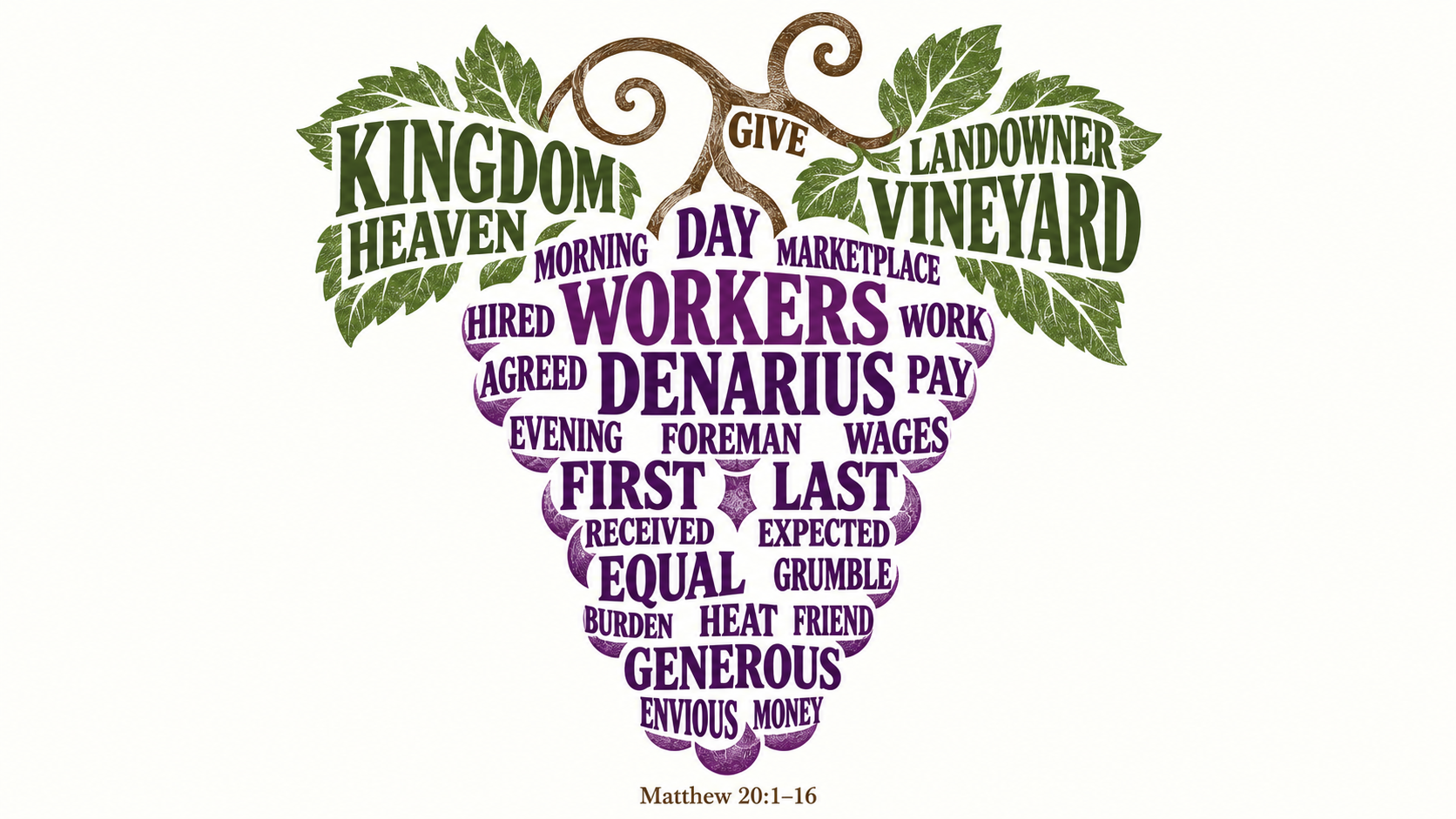
Matthew 20:1–16 asks a question we might rather avoid: can we celebrate God’s generosity when it reaches someone we think deserves less? Most of us welcome grace when we’re the ones who need it. We’re grateful that God doesn’t reduce us to our worst decision or calculate our worth by our accomplishments. Yet grace can become uncomfortable when someone else receives the welcome, forgiveness, or opportunity we believe we’ve worked harder to deserve.
Jesus tells a story about workers hired at different hours who receive the same payment. Some have worked through the heat. Others have barely begun before the day ends. We can understand why the first workers object. We know what it feels like to carry responsibility while someone else appears to receive the same benefit with less effort. Jesus allows us to feel that tension before asking us to examine what lies beneath it.
The story reveals a generous owner and workers whose satisfaction changes when they compare their wages. It also reveals people still waiting for an invitation late in the day. God’s grace reaches toward those people, too. No one becomes more valuable to God by arriving early, and no one becomes less worthy of His love because others have overlooked them.
The passage comforts people who fear they’ve come too late. It also challenges disciples who have begun treating years of faithfulness as a claim to greater importance. Jesus invites both groups to trust the goodness of the One who calls them.
Origin and Name
The Gospel takes its name from Matthew, also known as Levi, a tax collector
who became one of Jesus’ twelve disciples. That matters because Matthew’s own
calling reflects one of the Gospel’s central convictions: Jesus brings grace to
people others have written off. A tax collector becoming a disciple and witness
fits the larger story of a Messiah who calls sinners, heals outsiders, and
forms a new people by mercy (France).
Authorship
Early Christian tradition connects this Gospel with Matthew the apostle. The
Gospel itself does not name its author, but it shows deep knowledge of Jewish
Scripture, careful theological structure, and concern for the life and teaching
of the Church. It presents Jesus as the fulfillment of Israel’s story and the
authoritative teacher of God’s people (Keener).
Date and Setting
Matthew was likely written between AD 70 and 90, after the destruction of
the Jerusalem temple. Jewish and Christian communities were wrestling with
identity, authority, worship, and faithfulness in a changed world. Matthew
speaks into that setting by showing that Jesus is not a break from God’s
promises to Israel but their fulfillment (Davies and Allison).
Purpose and Themes
Matthew presents Jesus as Messiah, Son of David, Son of Abraham, Son of God,
and Immanuel. Major themes include fulfillment of Scripture, the kingdom of
heaven, righteousness shaped by mercy, discipleship, judgment, mission, and the
presence of Christ with His people. Matthew never separates grace from
obedience. Jesus calls people into mercy, forgiveness, transformation, and
faithful living.
Structure
Matthew weaves narrative and teaching together. The Gospel includes five
major teaching sections, often seen as echoing the five books of Moses. Jesus
appears as the greater teacher who fulfills and rightly interprets God’s will.
The Gospel moves from Jesus’ birth and identity, through His ministry and
teaching, into His suffering, death, resurrection, and final commissioning of
the disciples.
Significance
Matthew begins by identifying Jesus as Emmanuel and ends with His promise to remain with His followers always. Matthew 16:13–20 stands near the center of that story. The disciples are beginning to name clearly the One they’ve been following, but they still have to learn that His kingdom won’t look like the kingdoms around them.
France’s commentary gives particular attention to Matthew’s own literary and theological presentation of Jesus within the first-century setting. Keener likewise emphasizes the Gospel’s social setting and its call to discipleship.
Matthew 20:1–16 follows Peter’s question about what the disciples will receive after leaving everything to follow Jesus (Matthew 19:27). Jesus promises that their sacrifices matter, but He also warns that the positions of first and last will be reversed. The parable develops that warning. Its opening connection to the previous conversation matters: Jesus is teaching His own disciples, including those who have sacrificed much.
The surrounding stories deepen the point. Jesus welcomes children, challenges a wealthy man to relinquish his possessions, and speaks of God accomplishing what human beings cannot. After the parable, He predicts His suffering and death again. Then the request for prominent seats for James and John exposes the disciples’ continuing concern with status. Jesus answers by describing greatness through service and His own giving of His life (Matthew 19:13–26; 20:17–28).
Within the wider Bible, the parable stands beside Jonah’s anger at God’s mercy toward Nineveh and the older brother’s resentment when the lost son returns home. In each case, someone struggles with goodness extended beyond an accepted boundary. Deuteronomy 24:14–15 also provides a significant background: vulnerable laborers must receive their wages promptly. Scripture’s concern for grace never erases its concern for people’s daily needs.
The vineyard may recall Israel’s scriptural imagery, especially Isaiah 5:1–7. However, we shouldn’t turn every detail into a fixed code. Jesus doesn’t explicitly identify the different hiring groups as particular nations or historical eras. The story first addresses His disciples’ expectations. Any application to Gentile inclusion must avoid implying that God has stopped loving Israel.
Wesleyan theology helps us hold together God’s initiative, our response, and the transformation grace makes possible. Prevenient grace is God’s work before our conscious response. Justifying grace restores our relationship with God through faith in Christ. Sanctifying grace continues forming us in holy love. These are related descriptions of God’s gracious work, not separate supplies of favor we earn at different stages (United Methodist Communications).
The owner’s repeated invitations provide a useful illustration of grace taking the initiative. This is a theological application rather than a claim that Jesus intended each hiring hour to represent a formal stage of salvation. God reaches toward people before they can claim spiritual achievement. He loves those who aren’t yet following Him and enables a response without forcing it.
The equal payment also helps us reflect on the gift of salvation. A lifetime of service cannot purchase forgiveness. Someone who turns to Christ after many wasted years doesn’t receive a partial Savior or a lesser place in God’s family. We’re reconciled to God through Christ, not through a comparison of our religious records.
Yet grace does more than welcome us. It changes the way we see other people. Wesley describes grace as both undeserved mercy and God’s power at work within us. His discussion of Christian sincerity connects inward intention with outward conduct (Wesley). Applied here, holiness includes learning to rejoice when others receive mercy. We may be faithful workers and still need the Spirit to heal envy, pride, and resentment.
This also gives practical weight to works of mercy. We cannot celebrate the owner’s generosity while remaining indifferent to people who need work, food, dignity, or belonging. Our service doesn’t buy God’s love. It becomes one way His love takes visible form in our community.
Matthew 20:1: The Owner Goes Out
Jesus begins with the kingdom of heaven and an owner seeking workers for his vineyard. The initiative belongs to the owner. The story doesn’t begin with laborers presenting impressive qualifications or establishing a right to enter. Someone comes looking for them.
A vineyard is an ordinary working setting, and Jesus uses it to expose extraordinary generosity. The kingdom enters the familiar world of work, money, opportunity, and expectation. We shouldn’t move so quickly toward a spiritual meaning that the people in the marketplace disappear from view. These are laborers whose work and wages matter.
Matthew 20:2: An Agreement for the Day
The first workers agree to a denarius for their day’s labor. A denarius was a customary daily wage. Exact modern equivalents would be misleading because purchasing power and household circumstances differed. The important detail is the agreement: the workers know what the owner has promised, and the story will later return to that promise.
At this point, there is no dispute. Their eventual complaint won’t arise because their wage has been reduced. It will arise because someone else receives an unexpectedly generous payment. Jesus carefully establishes that distinction before the conflict begins.
Matthew 20:3: Others Are Still Waiting
Later that morning, the owner finds more people in the marketplace without work. The description of their inactivity must be read alongside verse 7. The text doesn’t establish laziness. Carroll points out that the language can be understood as being without employment rather than as a judgment on character (Carroll).
That distinction matters in ministry. We often see someone’s present circumstances before we understand what has brought them there. Being outside an opportunity doesn’t mean refusing an opportunity. A person may be waiting for someone to notice, invite, teach, or trust them. The passage asks us to listen before we assign blame.
Matthew 20:4: Trusting What Is Right
The owner sends these workers into the vineyard with an assurance of appropriate payment, but without naming a sum. They must trust his judgment. We shouldn’t turn their decision into a sentimental account of carefree faith. Workers needing employment may have limited bargaining power. Their uncertainty is part of the story’s human setting.
As a spiritual application, the scene invites us to consider whether we can follow Christ without demanding a complete explanation of what we’ll receive. Trust grows as we learn His character. We can bring honest questions while refusing to make discipleship a contract for personal advantage.
Matthew 20:5: The Invitation Continues
The workers go, and the owner returns at noon and again in the afternoon. The repeated trips slow the story down and draw our attention to people still being gathered. The vineyard hasn’t become a closed circle after the first hiring.
For a congregation, this is a searching picture. We may remember the people who were present at the beginning with affection and gratitude. We should. But a church’s history must remain open to the people God is calling now. An early invitation is a blessing to share, not a reason to stop inviting others.
Matthew 20:6: Even Near the End of the Day
The owner goes out again at about five in the afternoon, with little working time remaining. He questions those still waiting. Jesus doesn’t supply their ages, abilities, health conditions, or histories. We may imagine reasons they were overlooked, but we shouldn’t present our imagination as information supplied by Scripture.
What the story does give us is another encounter when hope of employment might be fading. As a pastoral application, this speaks to people who think their opportunity for a meaningful response to God has passed. Regret is real, but it doesn’t give us authority to declare that Christ can no longer call us.
Matthew 20:7: No One Has Hired Them
The late workers explain that no one has hired them. They don’t describe rejecting earlier offers or choosing leisure over responsibility. The owner sends them into the vineyard, too. There is no detailed wage negotiation in this final exchange.
Their response keeps the parable from becoming an excuse for deliberate delay. These workers respond when invited. For us, the hopeful word is that we can answer Christ today. The text doesn’t encourage us to refuse Him now while assuming that another opportunity will always be available.
Matthew 20:8: Payment Begins with the Last
At evening, the owner tells his foreman to pay the workers in reverse hiring order. This arrangement makes the unexpected generosity visible to those who worked longest. It prepares both the first workers and the hearer for the conflict that follows.
Evening payment also recalls the command to pay vulnerable workers before sunset in Deuteronomy 24:14–15. Their wages aren’t an abstract accounting entry. They support ordinary life. Grace has implications for how people are treated in the material world, including whether promises are kept and needs are taken seriously.
Matthew 20:9: A Full Payment for a Short Day
The last group receives a denarius. Jesus doesn’t explain this by saying they accomplished twelve hours’ work in one hour or possessed exceptional skill. The payment rests on the owner’s decision to give generously.
Read alongside the wider New Testament, this becomes an illuminating picture of salvation as a gift. Christ doesn’t require someone coming to faith late in life to recreate decades of missed opportunities before receiving forgiveness. There may be painful consequences to address and relationships to repair, but acceptance in Christ cannot be purchased by accumulating enough years of service.
Matthew 20:10: Expectation Changes
The first workers now expect a larger payment. Their reasoning is understandable: if one hour receives that much, surely their longer labor will receive more. However, the owner pays the agreed amount.
Comparison has changed the meaning of the same coin. What once represented an acceptable agreement now feels inadequate because of someone else’s good fortune. We recognize this movement when another person’s recognition, opportunity, or restoration makes our own life seem diminished. Nothing has been taken from us, yet we begin to feel deprived.
Matthew 20:11: The Complaint Comes into the Open
The first workers complain against the owner. Their response exposes a relationship strained by disappointed expectations. Jesus doesn’t pretend that resentment is an unusual temptation reserved for obviously unfaithful people. It can arise among those who have actually done the work.
That gives this verse pastoral force. A person can serve faithfully while carrying bitterness that needs attention. The answer isn’t to deny exhaustion or silence legitimate concerns. It is to distinguish the need for support from the desire to see someone else receive less.
Matthew 20:12: Equality Is the Offense
The workers identify the unequal hours and the burden they carried. But the sharpest part of their complaint is the owner’s decision to treat the last group as their equals. Their effort is real; their conclusion about superior standing is what the story challenges.
Churches can struggle here. Long service deserves gratitude, and experience can equip people for particular responsibilities. Yet neither establishes greater human worth or a stronger claim on God’s mercy. New believers, returning members, and people with difficult histories don’t need to spend years proving they deserve to be loved. Wise preparation for leadership and equal belonging in Christ are different questions.
Matthew 20:13: A Promise Has Been Kept
The owner answers one worker directly and points back to their agreement. He hasn’t withheld what he promised. His generosity to others hasn’t required him to reduce this worker’s payment.
We should also avoid treating his form of address as proof of a sentimental conversation. The Greek term translated as friend can accompany correction elsewhere in Matthew, including 22:12 and 26:50. Here the answer is firm. The worker must face the difference between an actual broken promise and an expectation created by comparison.
Matthew 20:14: The Owner Chooses to Give
The owner tells the worker to take his payment and states his intention to give the last worker the same amount. The difference in hours hasn’t escaped his notice. His action is deliberate.
God’s generosity isn’t an administrative mistake waiting for religious people to correct it. We sometimes act as though mercy needs our supervision because someone might receive more than their history warrants. But every forgiven disciple lives by a generosity larger than personal merit. Remembering that truth makes room for humility.
Matthew 20:15: The Question Behind the Complaint
The owner asks whether resentment has arisen because he is generous. The underlying Greek expression contrasts an evil eye with the owner’s goodness. In this setting, the image concerns envy or a grudging response to generosity (Powery).
This is the question the study brings home: what happens in me when God is good to someone else? I may affirm grace in principle while struggling when it reaches a particular person. The Spirit’s work includes making us honest about that struggle and teaching us to desire our neighbor’s good.
The owner’s freedom must also be read with his demonstrated faithfulness. This isn’t permission for powerful people to act cruelly because they control resources. The story presents generosity alongside a kept promise. Any application that excuses exploitation misses both the question Jesus asks and the wider biblical demand for justice.
Matthew 20:16: First and Last Reconsidered
Jesus closes by reversing first and last, returning to the warning at the end of chapter 19. The reversal challenges assumptions about entitlement and rank. In the actual payment, the workers receive the same amount. The late group’s welcome doesn’t require the early group’s exclusion.
Nor does this mean that every experienced disciple is condemned and every newcomer automatically faithful. Jesus is overturning the confidence that early arrival guarantees superior standing. The appropriate response is gratitude: gratitude for being called, gratitude for the work entrusted to us, and gratitude that God continues welcoming others.
An understandable objection is that the parable seems unfair. People who have worked longer have contributed more labor. We don’t need to deny that to hear Jesus. The owner fulfills his agreement and gives extra to others. The story questions whether generosity toward a neighbor must be treated as an injury to us. It doesn’t provide a complete policy for wages or invalidate the struggle against unfair working conditions.
Some interpreters offer a different reading. Saunders sees the owner’s public payment arrangement as a display of power that intensifies division among vulnerable workers. That reading warns against automatically identifying every powerful figure in a parable with God (Saunders). This study follows the generosity reading because the framing about first and last, the kept agreement, and the concluding question cohere with Jesus’ correction of His disciples’ pursuit of status. Nevertheless, the workers’ vulnerability deserves serious attention.
Another objection asks why faithful service matters if salvation is a gift. Christian service matters because God and our neighbors matter. Worship, mercy, and obedience are ways of participating in life with Christ. If we imagine that years spent following Jesus are wasted unless they purchase superiority, we’ve misunderstood the relationship He offers.
The passage also doesn’t establish that everyone is saved regardless of response to Christ. All the workers described accept the invitation and enter the vineyard. A parable about generosity shouldn’t be made to answer every question about final judgment. Read within the wider witness of Scripture, it encourages repentance and faith while denying that anyone can earn salvation. God loves people who turn away from Him, and His gracious invitation is real, but love doesn’t eliminate the possibility of refusal.
Finally, we shouldn’t divide the story into bad Jewish workers and good Christian workers. Jesus and His first disciples are Jewish. The immediate challenge is addressed to those already following Him. Christians who use the story to claim superiority over Jewish people reproduce the very attitude the parable confronts.
Begin by noticing where comparison changes gratitude into resentment. Someone else receives recognition, support, forgiveness, or a fresh beginning, and suddenly what we have feels smaller. We can bring that reaction honestly to God. A useful prayer is, “Lord, help me want their good without treating it as my loss.”
For longtime disciples, this passage invites renewed joy in service. The years weren’t wasted. The visits, prayers, meals, teaching, gifts, and quiet acts of faithfulness mattered. They helped real people and formed our lives with Christ. We can honor that history without turning it into a demand for greater worth than those arriving now.
For those coming to faith after years of distance, the passage offers hope without pretending the past was harmless. Repentance may include apology, restitution, and changed behavior. Yet you don’t have to erase your history before answering Jesus. Begin with the grace offered today. Receive His mercy and let Him teach you how to live from here.
For congregations, the owner’s repeated trips invite practical examination. Who remains outside because no one has invited them in a way they can receive? A friendly announcement isn’t always enough. Transportation, disability access, work schedules, fear of judgment, and unfamiliar language may affect participation. We can ask people what stands in their way instead of assuming they don’t care.
The passage also calls us to care about people whose economic circumstances are precarious. We can practice fair dealing, keep promises, support those seeking work, and respond to hunger without contempt. Seeing a person’s need should move us toward compassionate attention rather than a quick verdict about deservingness.
Finally, practice rejoicing on purpose. Thank God for someone else’s new beginning. Welcome the person whose story doesn’t resemble yours. Encourage a newer disciple without making them feel permanently junior in God’s affection. Grace becomes visible when people discover that our welcome reflects the goodness of the One who welcomed us.
Matthew 19:13–30: Children, wealth, discipleship, and the warning about first and last frame the parable.
Matthew 20:17–28: Jesus’ coming death and teaching on service correct the desire for status.
Deuteronomy 24:14–15: God commands prompt, just treatment of vulnerable laborers.
Isaiah 5:1–7: Vineyard imagery connects God’s people with His expectation of justice.
Jonah 3:10–4:11: Jonah struggles to welcome God’s compassion toward Nineveh.
Luke 15:25–32: The older brother resents the generous welcome of his returning brother.
Luke 23:39–43: A dying man turns to Jesus and receives a promise of life with Him.
Romans 5:6–8: Christ’s love reaches us in our sin and helplessness.
Ephesians 2:8–10: Salvation is God’s gift, and those saved by grace are created for good works.
Titus 3:3–7: God saves through His mercy rather than our righteous accomplishments.
James 2:1–9: Favoritism contradicts love of neighbor within the community of faith.
