
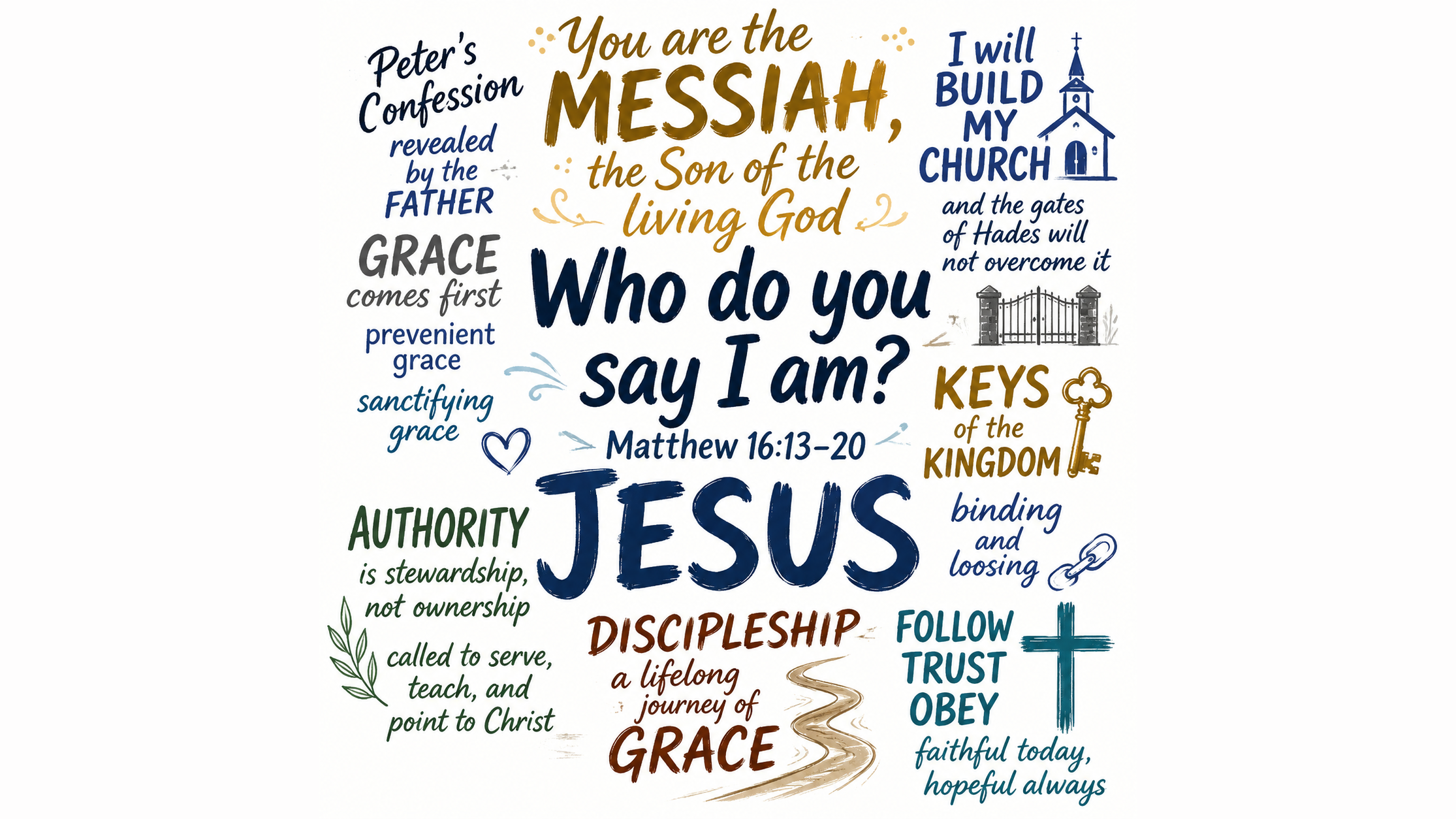
Matthew 16:13–20 brings the disciples to a turning point. They’ve watched Jesus teach with authority, heal the sick, cast out demons, calm storms, feed crowds, and welcome people others would rather avoid. Again and again, Matthew has raised the question of Jesus’ identity. People know He’s extraordinary, but knowing that Jesus is remarkable isn’t the same as knowing who He is.
Now Jesus asks the question directly.
He begins with what people are saying: “Who do people say the Son of Man is?” The answers are respectful. John the Baptist, Elijah, Jeremiah, or another prophet are all honorable comparisons. No one in the disciples’ report dismisses Jesus as insignificant. Yet every answer falls short. Jesus can be admired, respected, quoted, and even treated as a prophet while His true identity remains unrecognized.
Then Jesus makes the question personal: “But what about you? Who do you say I am?”
Peter answers, “You are the Messiah, the Son of the living God.”
This is one of the clearest confessions of Jesus’ identity in Matthew. Peter recognizes that Jesus isn’t simply another messenger sent by God. He is the Messiah, the One in whom Israel’s hopes are being fulfilled, and the Son of the living God. Jesus responds by saying Peter hasn’t reached this conclusion through ordinary human insight alone. The Father has revealed it to him.
What follows has generated centuries of discussion. Jesus calls Peter blessed, speaks of a rock on which He will build His Church, promises that the gates of Hades won’t overcome it, and gives Peter the keys of the kingdom. Christians have disagreed over exactly how Peter’s role should be understood, but the center of the passage is much clearer than the debates sometimes make it seem. Jesus is the Messiah. The Church belongs to Him. He builds it. Death cannot defeat what He is doing. The authority entrusted to His followers remains His authority, exercised under His lordship.
The passage also cannot be separated from what happens immediately afterward. Beginning in Matthew 16:21, Jesus tells the disciples that He must go to Jerusalem, suffer, die, and be raised. Peter correctly identifies Jesus as Messiah but still has to learn what kind of Messiah Jesus is. Confessing the right title is the beginning of discipleship, not its completion. Jesus will define Messiahship through the cross, and He will define discipleship the same way.
Origin and Name
The Gospel takes its name from Matthew, also known as Levi, a tax collector
who became one of Jesus’ twelve disciples. That matters because Matthew’s own
calling reflects one of the Gospel’s central convictions: Jesus brings grace to
people others have written off. A tax collector becoming a disciple and witness
fits the larger story of a Messiah who calls sinners, heals outsiders, and
forms a new people by mercy (France).
Authorship
Early Christian tradition connects this Gospel with Matthew the apostle. The
Gospel itself does not name its author, but it shows deep knowledge of Jewish
Scripture, careful theological structure, and concern for the life and teaching
of the Church. It presents Jesus as the fulfillment of Israel’s story and the
authoritative teacher of God’s people (Keener).
Date and Setting
Matthew was likely written between AD 70 and 90, after the destruction of
the Jerusalem temple. Jewish and Christian communities were wrestling with
identity, authority, worship, and faithfulness in a changed world. Matthew
speaks into that setting by showing that Jesus is not a break from God’s
promises to Israel but their fulfillment (Davies and Allison).
Purpose and Themes
Matthew presents Jesus as Messiah, Son of David, Son of Abraham, Son of God,
and Immanuel. Major themes include fulfillment of Scripture, the kingdom of
heaven, righteousness shaped by mercy, discipleship, judgment, mission, and the
presence of Christ with His people. Matthew never separates grace from
obedience. Jesus calls people into mercy, forgiveness, transformation, and
faithful living.
Structure
Matthew weaves narrative and teaching together. The Gospel includes five
major teaching sections, often seen as echoing the five books of Moses. Jesus
appears as the greater teacher who fulfills and rightly interprets God’s will.
The Gospel moves from Jesus’ birth and identity, through His ministry and
teaching, into His suffering, death, resurrection, and final commissioning of
the disciples.
Significance
Matthew begins by identifying Jesus as Emmanuel and ends with His promise to remain with His followers always. Matthew 16:13–20 stands near the center of that story. The disciples are beginning to name clearly the One they’ve been following, but they still have to learn that His kingdom won’t look like the kingdoms around them.
France’s commentary gives particular attention to Matthew’s own literary and theological presentation of Jesus within the first-century setting. Keener likewise emphasizes the Gospel’s social setting and its call to discipleship.
Matthew has been building toward Peter’s confession for several chapters. The disciples have already asked, after Jesus calmed the storm, “What kind of man is this?” In Matthew 14:33, after Jesus walked on the water, they worshiped Him and said, “Truly you are the Son of God.” The Canaanite woman called Him “Lord, Son of David.” Crowds have wondered whether He might be the promised Son of David.
The question is becoming unavoidable. Who is Jesus?
Immediately before this passage, Jesus warns the disciples about the “yeast” of the Pharisees and Sadducees. They misunderstand Him at first because they’re thinking about literal bread. Jesus reminds them of the feeding miracles and corrects their lack of understanding. Matthew is showing disciples whose spiritual vision is growing but still incomplete.
Then Jesus takes them into the region of Caesarea Philippi.
Caesarea Philippi lay well north of the usual center of Jesus’ Galilean ministry. Philip the tetrarch developed the city and named it in honor of Caesar while distinguishing it from the Caesarea on the Mediterranean coast. The wider area had longstanding associations with the worship of Pan and with Roman imperial power.
That setting gives additional weight to Peter’s confession, though we should be careful not to build more into the geography than Matthew actually says. In a region carrying the names and symbols of political and religious power, Jesus asks His disciples to say who they believe He is. Peter doesn’t name Caesar, Pan, or one prophet among many. He names Jesus as “the Messiah, the Son of the living God.”
The phrase “living God” emphasizes that Israel’s God isn’t an object created or controlled by human hands. He acts, speaks, reveals, saves, judges, and gives life. Peter’s confession places Jesus within the saving activity of this living God.
The passage also looks backward to Israel’s Scriptures. The “keys of the kingdom” likely recall Isaiah 22:22, where authority over the royal household is symbolized by a key. The person holding the key acts as a steward. He isn’t the king. He exercises authority delegated by the king.
That distinction matters for understanding Peter. Peter receives genuine responsibility, but the kingdom never becomes Peter’s possession. The Church isn’t Peter’s Church either. Jesus says, “I will build my church.” Christ remains the owner, builder, source, and Lord.
The passage also looks forward. Peter will become a major leader in the early Church. In Acts, he preaches at Pentecost, announces the gospel, participates in the inclusion of Gentiles, and helps the early Christian community discern what faithfulness requires. Yet Peter remains human. He can confess Christ in one moment and misunderstand Him in the next. His importance comes from Christ’s call and grace, not personal perfection.
Keener notes that Peter’s foundational role is closely connected with his confession of Jesus as Messiah. He also connects the keys with delegated royal authority and understands the gates of Hades primarily as the power of death rather than as a reference to a particular pagan cave at Caesarea Philippi.
Matthew 16:13–20 fits naturally with a Wesleyan understanding of grace that comes first and grace that calls for response.
Peter confesses Jesus, but Jesus immediately tells him that “flesh and blood” didn’t reveal this truth to him. The Father did. Peter hasn’t reasoned his way into salvation through superior intelligence. God has acted first.
This is the pattern Wesleyans recognize as prevenient grace. God takes the initiative. God awakens, calls, reveals, convicts, invites, and enables a response before we could ever claim the credit for ourselves.
Yet grace doesn’t remove Peter’s response. Jesus asks, “Who do you say I am?” Peter has to answer. God’s initiative doesn’t turn human beings into passive objects.
Randy Maddox describes Wesley’s theology through the idea of responsible grace, emphasizing both God’s gracious initiative and the meaningful human response that grace makes possible. Grace precedes us without coercing us. God makes faith possible, but human beings can respond, resist, receive, or turn away (Maddox). Maddox’s scholarship centers especially on Wesley’s practical theology and this interaction between divine grace and human response.
Peter’s confession illustrates that movement beautifully. The Father reveals. Peter confesses.
The next verses beyond our passage also show why Wesleyan theology doesn’t treat conversion or correct belief as the end of Christian formation. Peter knows who Jesus is but still misunderstands how Jesus will save. When Jesus speaks of suffering and the cross, Peter resists Him.
Peter needs sanctifying grace.
He must be transformed from a disciple who wants a triumphant Messiah on human terms into a disciple who understands the self-giving love of the cross. His ideas, desires, ambitions, and instincts all have to be shaped by Christ.
That transformation doesn’t happen instantly. Peter will continue making mistakes. He will deny Jesus. He will need forgiveness, restoration, the power of the Holy Spirit, the life of the Christian community, and continued correction. Grace doesn’t merely get Peter through the door. Grace keeps forming him.
The passage also speaks to social holiness. Jesus doesn’t promise to build isolated Christians. He says, “I will build my church.” Christian faith creates a people.
Wesley insisted that Christianity is fundamentally social. We’re formed through worship, Scripture, prayer, Holy Communion, Christian fellowship, accountability, and works of mercy. The Church isn’t a collection of spiritual consumers gathered around private religious preferences. It’s a community being formed by Christ and entrusted with His mission.
The authority represented by the keys must therefore be understood as stewardship rather than domination. The Church is entrusted with the gospel, discernment, teaching, discipline, forgiveness, and witness. Those gifts are given for the sake of God’s kingdom, not so Christian leaders can control people.
The One who gives the keys is also the One who will soon tell His disciples to take up a cross.
Christian authority must always look like Jesus.
Matthew 16:13, The Question Begins with the Crowd
Jesus asks, “Who do people say the Son of Man is?”
“Son of Man” is Jesus’ most frequent way of referring to Himself in the Gospels. The expression draws from ordinary language for a human being but also carries echoes of Daniel 7:13–14, where “one like a son of man” receives authority and an everlasting kingdom from God.
Jesus begins by asking about public opinion.
The disciples can answer that question easily. They’ve heard what people are saying. They know the conversations taking place around them.
There’s a difference, though, between reporting what other people believe and confessing what we believe ourselves.
Churches can become very good at discussing Jesus. We can explain what scholars say, what denominations teach, what our parents believed, or what our culture thinks about Christianity. Jesus eventually brings the question closer.
Before He does, He lets the disciples name the possibilities.
________________________________________
Matthew 16:14, Honorable Answers That Still Fall Short
The disciples answer, “Some say John the Baptist; others say Elijah; and still others, Jeremiah or one of the prophets.”
These aren’t insults.
John the Baptist was widely regarded as a prophet. Elijah carried enormous significance in Jewish hope and was expected to appear in connection with the coming day of the Lord. Jeremiah represented the great prophetic tradition of Israel.
The crowds recognize something true about Jesus. He speaks for God. He carries prophetic authority. His ministry demands attention.
Their problem isn’t that they think too little of Jesus in an ordinary sense. Their problem is that even their highest categories aren’t high enough.
This remains possible today.
Someone may call Jesus a gifted teacher, moral example, social reformer, prophet, spiritual guide, or remarkable historical figure. Some of those descriptions recognize genuine aspects of His ministry. None is enough by itself.
Christian faith finally depends upon who Jesus actually is.
________________________________________
Matthew 16:15, “But What About You?”
Jesus changes the question with one word: you.
“But what about you? Who do you say I am?”
The Greek pronoun is plural. Jesus addresses the disciples as a group, though Peter answers for them.
This is no longer a survey of public opinion.
The question calls for confession.
Every generation of Christians has to answer it. Every congregation does too. Our buildings, programs, traditions, budgets, missions, and ministries eventually reveal what we believe about Jesus.
If Jesus is merely an inspiring teacher, we can select the teachings we like and ignore the rest.
If He is the Messiah and Son of the living God, He has a claim upon the whole of our lives.
The question isn’t simply, “What do you think about Jesus?”
It is, “Who is He?”
________________________________________
Matthew 16:16, Peter’s Confession
Simon Peter answers, “You are the Messiah, the Son of the living God.”
“Messiah” translates the Hebrew idea of the anointed one. The Greek word is Christos, from which we get “Christ.”
Calling Jesus “Christ” wasn’t using His last name. It was confessing His identity.
Israel had known anointed kings, priests, and leaders, but hopes had developed for God’s promised ruler who would restore His people and establish God’s purposes. Expectations varied. Some imagined political deliverance, military victory, national restoration, purification of worship, or divine intervention.
Peter is right to call Jesus Messiah.
Yet the rest of Matthew 16 will show that Peter still fills the title with some of the wrong expectations.
He knows the answer before he understands what the answer means.
“The Son of the living God” takes the confession further. Matthew has already used “Son of God” language for Jesus, and the disciples confessed Him in those terms after He walked on the water. Here the confession becomes explicit and central.
Peter isn’t merely saying Jesus has a special relationship with God. Within Matthew’s unfolding story, Jesus is the beloved Son, Emmanuel, the One who exercises divine authority, forgives, rules creation, receives worship, and reveals the Father.
Keener observes that Peter is the first of Jesus’ close disciples in Matthew to make this explicit messianic confession in this form, though others in the Gospel have already used messianic titles for Jesus.
________________________________________
Matthew 16:17, Revelation Comes Before Recognition
Jesus responds, “Blessed are you, Simon son of Jonah.”
Peter is blessed, but Jesus immediately explains why.
“This was not revealed to you by flesh and blood, but by my Father in heaven.”
“Flesh and blood” is a Jewish way of referring to ordinary human beings or human ability. Peter’s confession ultimately depends upon God’s revelation.
This keeps Peter from becoming the hero of his own confession.
He has responded faithfully, but grace came first.
The same is true of Christian faith. We don’t stand above others because we were clever enough to discover what they missed. Faith should produce gratitude and humility, not spiritual pride.
If we see Christ clearly, grace has been at work.
And because grace was patient with us, we can be patient with those who are still asking questions, resisting, searching, doubting, or standing far from God.
God’s love extends toward them before they know how to name it.
________________________________________
Matthew 16:18, Peter, the Rock, and the Church
Jesus continues, “And I tell you that you are Peter, and on this rock I will build my church.”
The Greek contains a clear wordplay:
Petros, Peter.
Petra, rock.
Christians have debated the meaning for centuries.
Some Protestant interpretations have said the rock is solely Peter’s confession or Christ Himself. Roman Catholic interpretation has traditionally given Peter a unique foundational role connected with continuing Petrine authority.
The immediate wording makes it difficult to remove Peter entirely from the image. Jesus has addressed Simon, named him Peter, and then spoken of “this rock.” France argues that the wordplay and structure give Peter a genuine role in what Jesus is describing. Keener similarly understands Peter as foundational in connection with his confession of Jesus as Messiah (France; Keener).
That doesn’t mean Peter replaces Christ as the Church’s foundation in an ultimate sense.
Notice the verbs and possessives.
“I will build.”
“My church.”
Peter is important because Jesus calls and uses him.
Jesus remains the builder.
Jesus remains the owner.
The confession cannot be separated from the confessor, but neither can Peter be separated from the Christ he confesses.
Paul later describes the Church as built on the foundation of apostles and prophets with Christ Jesus Himself as the cornerstone in Ephesians 2:20. The apostolic witness matters because it points to Christ.
Matthew’s word for Church is ekklesia, meaning an assembly or gathered community. Matthew is the only Gospel writer to use the term, here and again in Matthew 18.
Jesus is promising to create a people who belong to Him.
The Church is therefore not fundamentally ours.
It isn’t the pastor’s church, the founding families’ church, the denomination’s church, or the congregation’s private possession.
It is Christ’s Church.
That truth is both comforting and corrective.
________________________________________
Matthew 16:18, “The Gates of Hades Will Not Overcome It”
Jesus promises that “the gates of Hades will not overcome it.”
Older translations often say “the gates of hell,” which can cause modern readers to picture demons charging from a fiery place or the Church attacking Satan’s fortress.
The Greek word is Hades, the realm of the dead.
Keener notes that “gates of Hades” was an ancient expression associated with death itself. Read in that light, Jesus is declaring that death won’t defeat the community He is building (Keener).
That promise becomes especially significant because Jesus is about to announce His own death.
The Church’s victory doesn’t come because Christians avoid death.
It comes because Jesus passes through death and rises.
The resurrection stands behind the promise.
Jesus will be crucified, but death won’t hold Him.
His disciples will suffer. Some will be martyred. Generations will pass. Empires will rise and fall. Congregations will begin and end. Yet the saving work of the risen Christ will continue.
The promise isn’t that every individual congregation will survive forever in its present form.
The promise is that death itself cannot defeat the Church Christ builds.
________________________________________
Matthew 16:19, The Keys of the Kingdom
Jesus tells Peter, “I will give you the keys of the kingdom of heaven.”
Keys represent authority and stewardship.
Isaiah 22:22 provides an important Old Testament background. There, a royal steward receives “the key to the house of David,” signifying responsibility within the king’s household.
Peter receives authority, but he remains a steward.
The kingdom belongs to God.
Peter doesn’t own the door.
He has been entrusted with the message that opens it.
In Acts, Peter will preach Jesus as crucified and risen. He will proclaim forgiveness and call people to repentance and faith. At Pentecost, thousands respond. Later he will enter the home of Cornelius and witness the Holy Spirit poured out upon Gentiles.
The keys are exercised through faithful witness to Christ.
Keener connects Peter’s kingdom authority particularly with his confession and proclamation of Jesus.
This should shape the Church’s understanding of authority today.
Christian authority isn’t permission to make grace difficult to reach.
Jesus sharply criticizes religious leaders elsewhere in Matthew for shutting the kingdom in people’s faces.
The Church is entrusted with the gospel so people can hear the invitation of Christ.
We proclaim truth clearly, but we don’t own grace.
________________________________________
Matthew 16:19, Binding and Loosing
Jesus continues, “Whatever you bind on earth will be bound in heaven, and whatever you loose on earth will be loosed in heaven.”
“Binding” and “loosing” were used in Jewish settings for authoritative decisions about what was forbidden or permitted. The language could include teaching, interpretation, discipline, and decisions about faithful community life.
Peter is being given serious responsibility.
Yet Matthew 18:18 later applies similar language to the wider disciple community. Whatever unique role Peter has here, Christ’s authority and responsibility aren’t eventually limited to Peter alone.
The Church must discern faithfully how the teaching of Jesus applies to life.
That’s a tremendous responsibility.
It should produce humility rather than arrogance.
Christians sometimes speak as though every personal opinion automatically carries heaven’s approval. This passage doesn’t give us permission to baptize our prejudices, preferences, politics, or traditions and declare them divine.
The authority is Christ’s.
The Church listens before it speaks.
We live under Scripture.
We seek the Holy Spirit.
We discern in community.
And because Jesus has shown us the character of God through mercy, holiness, truth, justice, forgiveness, and self-giving love, Christian discernment must bear the character of Christ.
________________________________________
Matthew 16:20, Why Keep It Secret?
Jesus then orders the disciples not to tell anyone that He is the Messiah.
That seems strange.
Peter has finally said the right thing. Why keep it quiet?
The answer comes immediately in verse 21.
The disciples know the title but don’t yet understand its meaning.
If they proclaim Jesus as Messiah while imagining the kind of Messiah they expect, they’ll spread a distorted message.
Jesus must define Messiahship before they proclaim it.
His road runs through Jerusalem.
It runs through rejection.
It runs through suffering.
It runs through the cross.
And then it runs out of the tomb.
Keener notes that the disciples weren’t yet prepared to understand Jesus’ kingship apart from popular expectations of victory and power. The cross would redefine what Messiah meant (Keener).
There’s a lesson here for the Church.
It’s possible to say the right words about Jesus while attaching the wrong values to Him.
We can call Him Lord while chasing power He refused.
We can confess Him as Messiah while avoiding the cross.
We can proclaim His kingdom while behaving like Caesar.
Jesus won’t let His title be separated from His way.
Matthew 16:13–20 raises a question that remains central to Christian faith: Who is Jesus?
The passage itself recognizes that different explanations existed even during Jesus’ ministry. People didn’t all reach the same conclusion from seeing or hearing Him. Some placed Him within familiar prophetic categories.
That diversity is significant. Matthew doesn’t portray belief as automatic or unavoidable. People encounter Jesus and interpret Him differently.
Christian faith makes a stronger claim than saying Jesus was unusually wise or spiritually gifted. Peter confesses Him as Messiah and Son of the living God.
Matthew then places this confession in a narrative where Jesus’ actions have been steadily forcing the question. He forgives sins, exercises authority over illness and demonic powers, teaches with unusual authority, commands creation, receives worship, feeds multitudes, and identifies Himself with God’s kingdom.
The confession doesn’t appear out of nowhere.
At the same time, Matthew doesn’t turn Peter into an idealized witness whose understanding is flawless. Within a few verses Peter will rebuke Jesus and receive one of the strongest corrections in the Gospel. Later he’ll deny knowing Jesus.
That honesty matters.
The Gospel’s claim doesn’t depend upon Peter being impressive.
It depends upon Jesus being who Peter confesses Him to be.
Christian faith finally rises or falls with Jesus Himself.
If Jesus is merely one religious teacher among many, the Church’s claims about Him are excessive.
If He is the crucified and risen Messiah, Son of the living God, then no part of life remains untouched by His lordship.
Jesus’ question still reaches us: “Who do you say I am?” We can know what the Church teaches and repeat the right words, but confession becomes meaningful when it shapes the way we live. If Jesus is the Messiah and Son of the living God, then He has a claim on our choices, relationships, priorities, fears, and hopes. Following Him means more than admiring Him. It means trusting His authority and allowing His grace to keep changing us.
Jesus also reminds us whose Church this is when He says, “I will build my church.” The Church doesn’t belong to pastors, leaders, founding families, denominations, or congregations. It belongs to Christ. We’re responsible for being faithful, loving our neighbors, making disciples, serving those in need, and proclaiming the gospel, but we don’t carry the burden of saving the Church. Christ is the builder, and we serve under His direction.
The keys of the kingdom remind us that Christian authority is stewardship rather than ownership. Whatever responsibility Christ gives His Church should reflect His character. Authority used to protect status, control people, or exclude those we find inconvenient has lost sight of Jesus. The One who gives the keys is also the One who welcomes sinners, serves the vulnerable, forgives His enemies, and gives His life for the world.
Jesus’ promise that the gates of Hades won’t overcome His Church gives us hope when life feels uncertain. Christians still grieve, congregations still struggle, and institutions still change, but death doesn’t have the final word. The Church belongs to the risen Christ. Our hope rests in the One who entered death and came out of the grave.
Peter also reminds us that discipleship is a continuing work of grace. He makes the right confession and then almost immediately misunderstands Jesus. Christ doesn’t discard him. He corrects him, restores him, and continues shaping him. We confess Jesus as Messiah, and then we spend our lives learning what that confession means. Grace meets us where we are and keeps forming us into people who trust, follow, and reflect Christ more faithfully.
Daniel
7:13–14
Isaiah 22:20–22
Psalm 18:1–3
Matthew 3:13–17
Matthew 7:24–27
Matthew 11:25–27
Matthew 14:22–33
Matthew 16:21–28
Matthew 18:15–20
Matthew 23:13
Matthew 26:69–75
Matthew 28:16–20
Luke 22:31–32
John 6:66–69
John 21:15–19
Acts 2:14–41
Acts 10:34–48
Ephesians 2:19–22
1 Peter 2:4–10
