
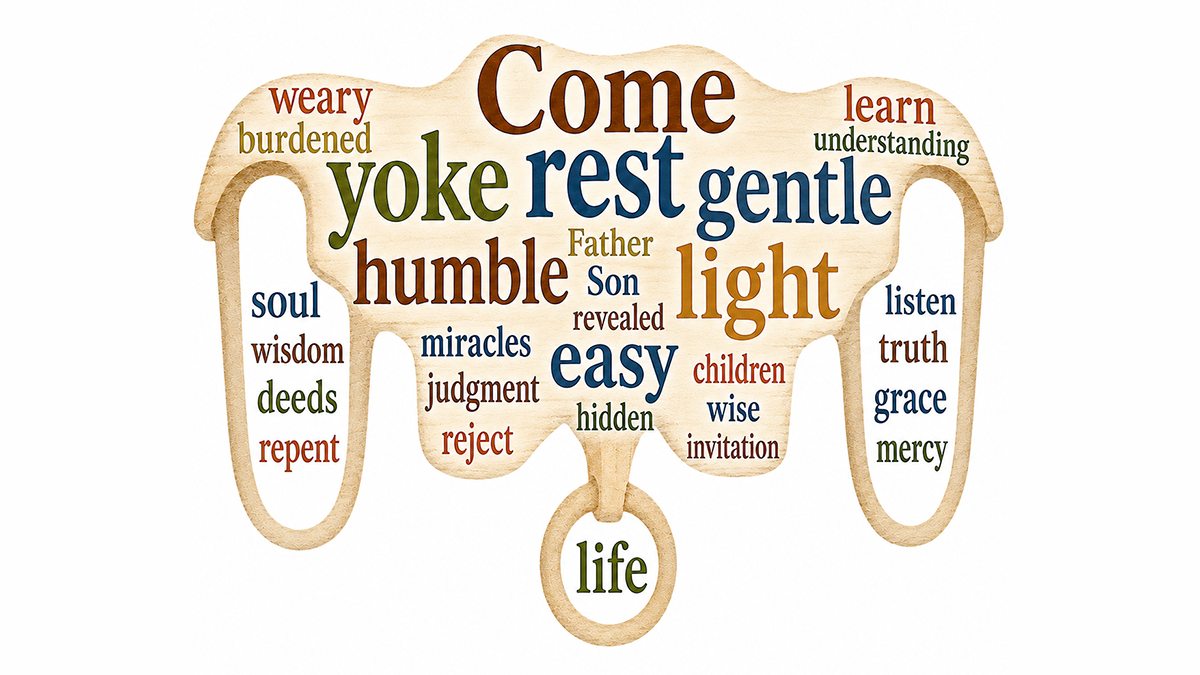
Matthew 11:16–30 speaks into the weariness that comes from trying to make sense of people, pain, disappointment, and faith all at the same time. Jesus has just spoken about John the Baptist, the prophet who prepared the way and now sits in prison. John’s situation raises hard questions. If the kingdom has come near, why is God’s messenger still suffering? If Jesus is the promised One, why does the world still feel so heavy?
Jesus does not answer those questions by pretending life is simple. He names the confusion of the crowd, the resistance of the towns, and the hiddenness of God’s work. Some people rejected John because he was too severe. They rejected Jesus because He was too gracious. They wanted God to move according to their expectations, but God’s wisdom came in a form they did not want to receive (France).
This passage holds judgment and grace together. Jesus speaks hard words over cities that saw His works and still refused to turn. Yet the passage does not end with condemnation. It ends with one of the most tender invitations in Scripture, “Come to me, all you who are weary and burdened, and I will give you rest.” Jesus does not deny the weight people carry. He calls the weary to Himself and offers a yoke that does not crush but restores.
Matthew reminds us that the kingdom of God is not built around human pride, religious performance, or public approval. It is revealed to those humble enough to receive it. The ones who come to Jesus are not the ones who have everything figured out. They are the tired, the burdened, the overlooked, and the honest. Grace meets them there.
Origin and Name
The Gospel takes its name from Matthew, also known as Levi, a tax collector
who became one of Jesus’ twelve disciples. That matters because Matthew’s own
calling reflects one of the Gospel’s central convictions: Jesus brings grace to
people others have written off. A tax collector becoming a disciple and witness
fits the larger story of a Messiah who calls sinners, heals outsiders, and
forms a new people by mercy (France).
Authorship
Early Christian tradition connects this Gospel with Matthew the apostle. The
Gospel itself does not name its author, but it shows deep knowledge of Jewish
Scripture, careful theological structure, and concern for the life and teaching
of the Church. It presents Jesus as the fulfillment of Israel’s story and the
authoritative teacher of God’s people (Keener).
Date and Setting
Matthew was likely written between AD 70 and 90, after the destruction of
the Jerusalem temple. Jewish and Christian communities were wrestling with
identity, authority, worship, and faithfulness in a changed world. Matthew
speaks into that setting by showing that Jesus is not a break from God’s
promises to Israel but their fulfillment (Davies and Allison).
Purpose and Themes
Matthew presents Jesus as Messiah, Son of David, Son of Abraham, Son of God,
and Immanuel. Major themes include fulfillment of Scripture, the kingdom of
heaven, righteousness shaped by mercy, discipleship, judgment, mission, and the
presence of Christ with His people. Matthew never separates grace from
obedience. Jesus calls people into mercy, forgiveness, transformation, and
faithful living.
Structure
Matthew weaves narrative and teaching together. The Gospel includes five
major teaching sections, often seen as echoing the five books of Moses. Jesus
appears as the greater teacher who fulfills and rightly interprets God’s will.
The Gospel moves from Jesus’ birth and identity, through His ministry and
teaching, into His suffering, death, resurrection, and final commissioning of
the disciples.
Significance
Matthew bridges the story of Israel and the mission of the Church. It shows
that God’s covenant promises continue through Jesus and now move outward to all
nations. The final scene in Matthew 28 does not close the story as much as it
opens the Church’s mission.
Matthew 11 comes after Jesus has called disciples, healed the sick, taught about the kingdom, and sent His followers out in mission. Yet the response to Jesus is mixed. Some are amazed. Some are offended. Some are curious but unmoved. John the Baptist has questions from prison, and Jesus answers by pointing to the works of the kingdom, the blind receive sight, the lame walk, the lepers are cleansed, the deaf hear, the dead are raised, and good news is preached to the poor.
Matthew 11:16–30 shows the growing divide between those who receive Jesus and those who resist Him. The crowds have seen enough to respond, but many still refuse. They criticize John for fasting and criticize Jesus for eating with sinners. Their problem is not lack of evidence. Their problem is a heart that will not be satisfied unless God comes on their terms (Keener).
Within the wider biblical story, this passage echoes the wisdom tradition of the Old Testament. God’s wisdom is often rejected by the proud but received by the humble. Jesus speaks as more than a prophet or teacher. He speaks as the Son who uniquely knows the Father and reveals the Father to others. This places Him at the center of God’s self-revelation (France).
The invitation to take Christ’s yoke also connects with Old Testament images of wisdom, Torah, and covenant faithfulness. A yoke could symbolize obedience, teaching, or submission. Jesus does not offer freedom from all responsibility. He offers the right Master. His yoke leads to life because He is gentle and humble in heart (Wright).
John Wesley would have heard prevenient grace in Jesus’ invitation, “Come to me.” Jesus calls before people have fixed themselves. He reaches toward the weary before they have learned how to carry their burdens well. Grace comes first. It awakens, invites, and makes response possible (Collins).
This passage also reflects Wesley’s understanding of repentance and holiness. The cities of Chorazin, Bethsaida, and Capernaum had received great light, yet they did not turn. In Wesleyan theology, grace can be resisted. God truly invites, but people can harden themselves against the mercy placed before them. Love does not force obedience. It calls, convicts, and waits for a real response (Wesley).
At the same time, Jesus’ promise of rest is not a call to spiritual laziness. Wesley understood the Christian life as a life of grace-shaped obedience. Taking Christ’s yoke means learning from Him, walking with Him, and being formed by Him. The difference is that Jesus’ yoke is not crushing. It is not the burden of earning God’s love. It is the path of living inside the love already given.
For Wesley, holiness was never cold religious performance. It was love of God and neighbor filling the heart and shaping the life. Matthew 11:28–30 fits that vision beautifully. Jesus receives the weary, teaches them His way, and gives them rest for their souls.
Matthew 11:16–19, A Generation That Won’t Be Satisfied
Jesus compares His generation to children sitting in the marketplace, calling out to others who refuse to join either a wedding song or a funeral song. The image is simple but sharp. No matter what tune is played, the people will not respond. They reject both mourning and joy.
John the Baptist came with fasting, simplicity, and prophetic urgency. Many dismissed him as extreme. Jesus came eating and drinking, sitting at tables with tax collectors and sinners. Many dismissed Him as morally careless. The issue was not John’s style or Jesus’ style. The issue was resistance to God’s call (France).
This is a warning against the kind of religion that always finds a reason not to respond. Some people reject conviction because it feels too hard. Others reject grace because it feels too generous. John and Jesus were different in method, but both were sent by God. Refusing both reveals a heart more interested in control than truth.
Jesus says, “Wisdom is proved right by her deeds.” In other words, God’s wisdom will be shown true by what it produces. John’s ministry prepared the way. Jesus’ ministry brought healing, mercy, forgiveness, and the presence of the kingdom. The fruit reveals the truth, even when critics refuse to see it (Keener).
Matthew 11:20–24, The Danger of Seeing and Still Refusing
Jesus then denounces the towns where many of His miracles had been performed because they did not repent. Chorazin, Bethsaida, and Capernaum had received extraordinary signs of God’s kingdom. They had seen mercy with their own eyes. Yet they remained unchanged.
These words are hard, but they are not careless. Jesus is not angry because people failed to meet a religious standard they never understood. He grieves and judges because they were given great light and refused it. In Scripture, greater revelation brings greater responsibility (Davies and Allison).
Jesus compares these towns to Tyre, Sidon, and Sodom, places remembered for wickedness and judgment. His point is not that Gentile cities were righteous. His point is that the people who thought they were spiritually secure were in greater danger because they had rejected the clearest witness of God’s grace.
Capernaum had been a center of Jesus’ ministry. It had heard His teaching and seen His works. Yet privilege did not produce repentance. Being near holy things is not the same as surrendering to the Holy One. A person can be surrounded by sermons, prayers, Scripture, worship, and miracles of mercy and still keep the heart closed.
This section reminds the Church that familiarity can become dangerous when it dulls our response. The question is not only, “Have we heard?” The deeper question is, “Have we turned?”
Matthew 11:25–27, The Kingdom Revealed to the Humble
After speaking judgment over unrepentant towns, Jesus turns to prayer. He praises the Father because the truth of the kingdom is hidden from the “wise and learned” and revealed to “little children.” Jesus is not condemning learning itself. Matthew’s Gospel is too deeply thoughtful and scriptural for that. He is confronting pride, self-sufficiency, and the assumption that human status gives someone better access to God (France).
“Little children” refers to those who receive rather than control. They are dependent, open-handed, and teachable. The kingdom is not earned by intellectual achievement or religious reputation. It is received by humble trust.
Jesus then makes a stunning claim. “All things have been committed to me by my Father.” No one truly knows the Son except the Father, and no one truly knows the Father except the Son and those to whom the Son chooses to reveal Him. This is one of the clearest statements in Matthew about the unique relationship between Jesus and the Father (Keener).
Jesus does not simply bring information about God. He reveals God. To know Jesus is to see the heart of the Father. This matters pastorally because many people imagine God as harsh, distant, or impossible to please. Jesus shows us that the Father’s heart is holy, truthful, merciful, and full of redeeming love.
Matthew 11:28–30, Rest for the Weary
The passage reaches its grace-filled center in Jesus’ invitation, “Come to me, all you who are weary and burdened, and I will give you rest.” The invitation is personal. Jesus does not say, “Come to a system,” “Come to an argument,” or “Come to a religious performance.” He says, “Come to me.”
The weary and burdened may include those worn down by sin, suffering, poverty, grief, religious pressure, and the daily weight of life. In Matthew’s context, Jesus is also speaking to people burdened by forms of religious leadership that made obedience heavy without offering mercy. Later, Jesus will condemn leaders who tie up heavy loads and place them on others’ shoulders without lifting a finger to help (Wright).
Jesus offers rest, but He also says, “Take my yoke upon you and learn from me.” A yoke was used for work, guidance, and shared movement. Jesus is not offering escape from discipleship. He is offering discipleship under a gracious Lord. His yoke fits because it is shaped by His own heart.
Jesus describes Himself as “gentle and humble in heart.” This matters. The One who has all authority is not cruel. The One who reveals the Father is not harsh with the broken. The One who calls us to obedience also carries us in mercy.
His burden is light not because life is easy, but because grace changes the weight. We are no longer carrying the burden of proving ourselves worthy of love. We are no longer trying to save ourselves. We are learning from the Savior who has already come near.
This passage helps answer the claim that Christian faith is only wishful thinking or emotional comfort. Matthew does not present a world where everyone responds neatly to Jesus. The Gospel is honest about doubt, rejection, judgment, pride, and weariness. That honesty gives the text moral weight.
Historically, the passage fits the real tensions of first-century Jewish life under Roman rule. John the Baptist’s imprisonment, public expectations of the Messiah, honor and shame, village reputation, and debates over holiness all belong to the world Matthew describes (Keener).
Theologically, this passage shows that Christianity does not rest on vague spirituality. It centers on Jesus’ unique relationship with the Father. Jesus claims authority to reveal God and to give rest to the soul. That is either too large to ignore or too beautiful to dismiss lightly.
Philosophically, the passage speaks to a universal human problem. People often want truth, but only if it comes in a form they already approve. Jesus exposes that resistance. He also answers the deeper ache beneath it. Human beings are tired from trying to carry what only God can carry. The Christian claim is that rest is not found by escaping God but by coming to Christ.
Many people still live like the children in the marketplace. We want God to play the song we prefer. We want conviction without discomfort, grace without surrender, and truth without change. Jesus loves us too much to let us stay there.
This passage asks us to examine our excuses. Are we rejecting God’s call because it feels too demanding? Are we rejecting His mercy because it reaches people we would rather judge? Are we so familiar with church that we have stopped being moved by Christ?
It also speaks tenderly to the exhausted. Jesus does not shame the weary for being weary. He invites them. He does not tell the burdened to pretend they are strong. He offers rest. This is good news for people carrying grief, guilt, ministry fatigue, family strain, financial worry, health concerns, and quiet spiritual heaviness.
The call is not simply to lay down burdens. It is to take up Christ’s yoke. We lay down the crushing weight of self-salvation and take up the life-giving way of learning from Jesus. His way includes obedience, but it is obedience held in love. His way includes repentance, but repentance opens the door to healing. His way includes surrender, but surrender leads to rest.
The Church should sound like this invitation. We should tell the truth about sin and judgment, but we should never forget where Jesus ends this passage. He opens His arms to the weary and says, “Come to me.”
Isaiah 55:1–3
Jeremiah 6:16
Micah 6:8
Matthew 23:4
John 14:6–11
Romans 2:4
Galatians 5:1
Hebrews 4:14–16
1 John 5:3
