
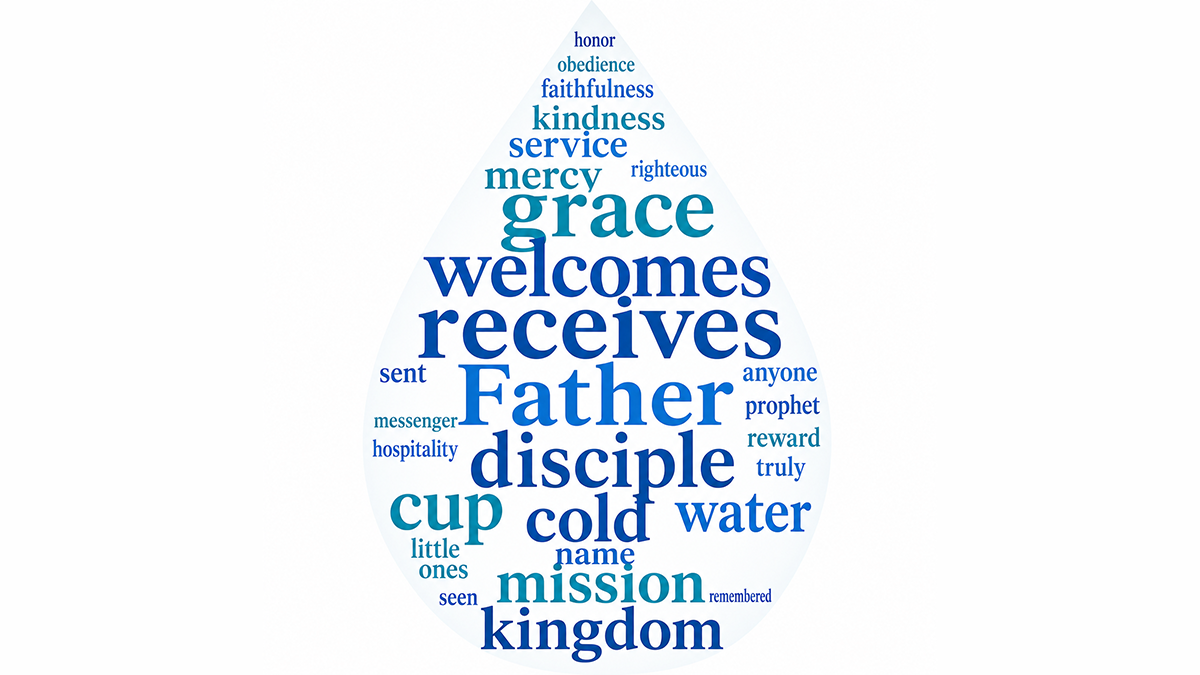
Matthew 10:40–42 brings Jesus’ missionary instructions to a quiet but weighty close. Much of Matthew 10 has sounded hard. Jesus has warned the disciples about rejection, conflict, persecution, fear, and the cost of following Him. Then, at the end, He turns our attention to welcome. The disciples will go out vulnerable, dependent on the hospitality of others, but they do not go alone. Whoever receives them receives Jesus, and whoever receives Jesus receives the One who sent Him.
This short passage reminds us that God’s kingdom often moves through ordinary acts of faithfulness. A prophet may speak with courage. A righteous person may live with steady obedience. A “little one” may seem weak, unknown, or easy to overlook. Yet Jesus says that receiving any of them matters. Even a cup of cold water given in love is seen by God. Nothing done in the name of Christ is wasted.
Matthew wants us to understand that discipleship is never separated from Jesus’ presence. The one sent by Christ carries more than a message. They bear witness to the Sender. In the ancient world, a messenger represented the authority of the one who sent him. To welcome the messenger was to honor the sender (Keener). Jesus takes that familiar idea and fills it with kingdom grace. To welcome His disciples is to welcome Him.
This is good news for the Church. We often measure ministry by size, visibility, and results. Jesus measures faithfulness differently. He sees the quiet welcome, the unnoticed kindness, the humble servant, and the simple gift offered in love. The kingdom of heaven is not only revealed in public preaching and powerful moments. It is also revealed when one person receives another with grace.
Origin and Name
The Gospel takes its name from Matthew, also known as Levi, a tax collector
who became one of Jesus’ twelve disciples. That matters because Matthew’s own
calling reflects one of the Gospel’s central convictions: Jesus brings grace to
people others have written off. A tax collector becoming a disciple and witness
fits the larger story of a Messiah who calls sinners, heals outsiders, and
forms a new people by mercy (France).
Authorship
Early Christian tradition connects this Gospel with Matthew the apostle. The
Gospel itself does not name its author, but it shows deep knowledge of Jewish
Scripture, careful theological structure, and concern for the life and teaching
of the Church. It presents Jesus as the fulfillment of Israel’s story and the
authoritative teacher of God’s people (Keener).
Date and Setting
Matthew was likely written between AD 70 and 90, after the destruction of
the Jerusalem temple. Jewish and Christian communities were wrestling with
identity, authority, worship, and faithfulness in a changed world. Matthew
speaks into that setting by showing that Jesus is not a break from God’s
promises to Israel but their fulfillment (Davies and Allison).
Purpose and Themes
Matthew presents Jesus as Messiah, Son of David, Son of Abraham, Son of God,
and Immanuel. Major themes include fulfillment of Scripture, the kingdom of
heaven, righteousness shaped by mercy, discipleship, judgment, mission, and the
presence of Christ with His people. Matthew never separates grace from
obedience. Jesus calls people into mercy, forgiveness, transformation, and
faithful living.
Structure
Matthew weaves narrative and teaching together. The Gospel includes five
major teaching sections, often seen as echoing the five books of Moses. Jesus
appears as the greater teacher who fulfills and rightly interprets God’s will.
The Gospel moves from Jesus’ birth and identity, through His ministry and
teaching, into His suffering, death, resurrection, and final commissioning of
the disciples.
Significance
Matthew bridges the story of Israel and the mission of the Church. It shows
that God’s covenant promises continue through Jesus and now move outward to all
nations. The final scene in Matthew 28 does not close the story as much as it
opens the Church’s mission.
Matthew 10:40–42 closes Jesus’ instructions to the twelve disciples before He sends them out. Earlier in the chapter, Jesus gives them authority to heal, cast out demons, proclaim the kingdom, and serve freely. He also warns them that mission will not always be welcomed. Some will reject them. Some will oppose them. Some relationships may become strained because of loyalty to Christ.
These final verses do not erase the cost of discipleship, but they remind the disciples that God is still at work through their witness. Their mission depends not only on their preaching but also on the responses of those who receive them. The people who welcome them become part of the kingdom’s work.
Within the wider biblical story, this passage connects to the Old Testament pattern of receiving God’s messengers. Those who welcomed prophets often found themselves drawn into God’s blessing, while those who rejected God’s messengers rejected the God who sent them. Jesus stands in that same prophetic tradition, yet He is more than a prophet. He is the Son who reveals the Father (Wright).
The passage also points ahead to the Church’s mission. The followers of Jesus will go into the world as witnesses, not as people seeking status, but as servants who depend on God’s grace and the hospitality of others.
John Wesley would have heard in this passage both grace and holy living. The grace of God does not only call people to believe. It also forms them into people who welcome, serve, and love. A cup of cold water given in Christ’s name becomes an act of mercy.
Wesley often joined faith with practical holiness. Love of God and love of neighbor belong together. In Matthew 10:40–42, receiving Christ’s messenger is not a small thing because Christ is present in the act of welcome. God’s grace moves through both the one who goes and the one who receives.
This passage also fits Wesley’s emphasis on works of mercy. The cup of cold water does not earn salvation. It is not a transaction with God. It is a sign that grace has touched the heart and begun to shape the hands. God’s reward is not payment for human achievement. It is the generous recognition of faith working through love (Collins).
Matthew 10:40, Receiving the One Who Sends
Jesus says, “Anyone who welcomes you welcomes me, and anyone who welcomes me welcomes the one who sent me.” This verse rests on the idea of representation. In the ancient world, a messenger carried the authority of the sender. To reject the messenger was to reject the one who sent him. To receive the messenger was to receive the sender (Keener).
Jesus applies that idea to His disciples. They are not important because of personal status. They are important because they belong to Him. Their authority is borrowed. Their mission is received. Their presence points beyond themselves to Christ and beyond Christ to the Father.
This gives dignity to Christian witness. When disciples go in obedience, they do not go alone. Christ is present in their mission. It also gives weight to hospitality. Welcoming one of Christ’s servants is not just politeness. It is a spiritual response to Jesus Himself.
Matthew 10:41, Welcoming the Prophet and the Righteous
Jesus then speaks of receiving a prophet “as a prophet” and a righteous person “as a righteous person.” The wording matters. To receive a prophet as a prophet means to honor the message of God that prophet carries. To receive a righteous person as righteous means to welcome a life shaped by faithfulness.
The reward Jesus mentions should not be reduced to wages earned. Matthew often speaks of reward as God’s gracious recognition of faithfulness. The point is not that people can buy blessing by being nice to religious figures. The point is that when we welcome God’s work in others, we participate in that work (France).
This verse also challenges the temptation to separate private faith from public welcome. If we honor God, we must learn to honor those God sends, including those whose lives call us toward deeper obedience.
Matthew 10:42, The Cup of Cold Water
Jesus ends with the smallest act, “a cup of cold water.” It is simple, practical, and available to almost anyone. This is not a grand donation or public sacrifice. It is basic care for someone who is thirsty.
The “little ones” here likely refers to Jesus’ disciples in their vulnerability. They are sent out with little power, little protection, and little social standing. They may be easy to dismiss. Yet Jesus identifies Himself with them and promises that even the smallest kindness shown to them will not be forgotten (Davies and Allison).
This verse is full of grace. God sees what others overlook. God values what the world may dismiss. A cup of cold water given because someone belongs to Christ matters in the kingdom of heaven.
Matthew 10:40–42 gives a historically grounded picture of early Christian mission. The passage reflects the real social world of travel, hospitality, messengers, and household welcome. Before modern hotels, phones, and travel systems, hospitality was essential for survival and mission. This setting makes Jesus’ words practical, not abstract (Keener).
Theologically, the passage shows the unity of Father, Son, and disciple. The mission of the Church does not begin with human ambition. It begins with the Father sending the Son and the Son sending His followers. Christian mission rests on divine initiative.
Philosophically, the passage answers a deep human fear, the fear that small acts do not matter. Jesus says they do. In a world that often celebrates scale, platform, and influence, Jesus dignifies hidden faithfulness. The smallest mercy offered in love has eternal weight.
Matthew 10:40–42 calls the Church to take both mission and hospitality seriously. Some are sent to speak, teach, visit, pray, serve, and lead. Others support the mission by receiving, encouraging, feeding, listening, and making room. Jesus honors both.
This passage is especially important for small churches and ordinary believers. Not everyone will preach to crowds. Not everyone will hold a title. Not everyone will be noticed. But everyone can offer welcome. Everyone can give the cup of cold water. Everyone can make space for Christ by receiving the people Christ sends.
It also asks us to pay attention to the “little ones.” Who is easy to overlook? Who is serving quietly? Who is tired from the road? Who needs encouragement? Who needs to be reminded that they are not alone?
The love and grace of God are often carried through simple acts. A meal, a note, a prayer, a ride, a visit, a listening ear, a cup of water, these can become signs of the kingdom when offered in Jesus’ name.
Genesis 18:1–8
1 Kings 17:8–16
2 Kings 4:8–10
Matthew 25:34–40
Luke 10:16
John 13:20
Hebrews 13:1–2
