February 4, 2026
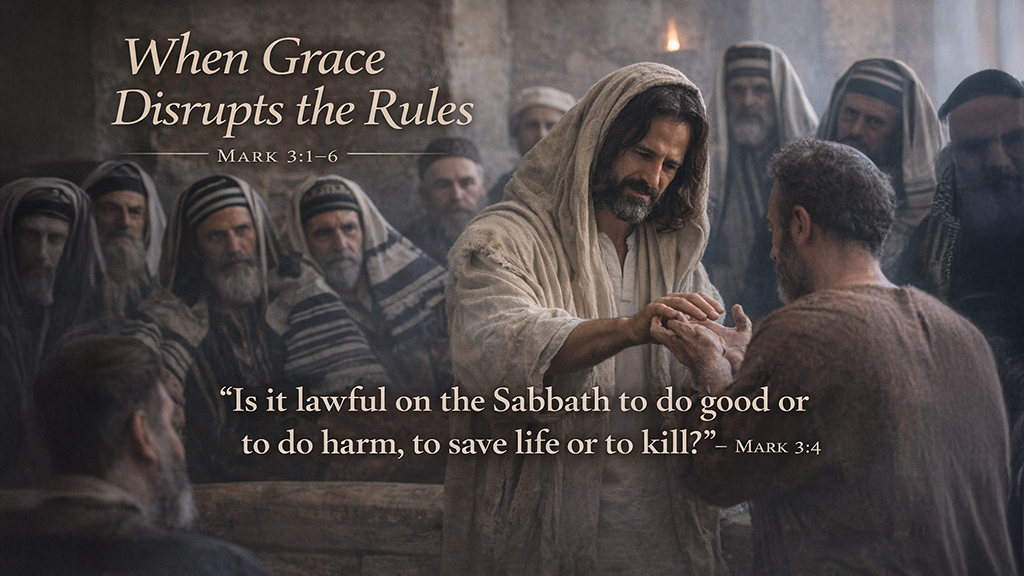
In Mark 3:1-6, Jesus enters the synagogue on the Sabbath and notices a man with a withered hand. Others are watching closely, not to celebrate healing, but to see whether Jesus will break the rules. Jesus asks a simple, piercing question about doing good or doing harm. He chooses to heal, revealing that God’s concern for people outweighs rigid rule-keeping. In this moment, Jesus shows that justice and mercy are never violations of God’s will, even when they disrupt expectations.
Devotional: There’s a certain comfort in rules. They give us clarity. They tell us where the lines are and help us feel secure. When life gets complicated, rules can feel like anchors. Follow them and you know you’re doing what’s expected. But rules can also become shields, ways to avoid the harder work of compassion.
This scene in the synagogue feels tense because everyone knows what’s at stake. It’s the Sabbath. The rules are clear. And then there’s a man whose hand doesn’t work, standing in plain sight. His need is obvious, but it’s inconvenient. Helping him would stir controversy. Ignoring him would be easier.
Jesus doesn’t rush past the moment. He looks around at the people watching Him and asks a question that still unsettles us. Is it better to do good or to do harm? To save life or to destroy it? No one answers. Silence fills the room. Silence often shows where we’re stuck between what’s right and what’s safe.
Jesus chooses mercy, even though He knows it will cost Him. He heals the man, restoring not just a hand, but dignity and wholeness. And in doing so, He exposes how easily faith can become more concerned with rule-keeping than with people. The tragedy isn’t that the rules exist. It’s that they’re used to justify indifference.
Most of us don’t face moments this dramatic, but we face quieter versions of the same choice. Do we stick to what’s expected, or do we respond to the need in front of us? Do we protect our comfort, or do we risk misunderstanding for the sake of kindness? Grace often disrupts our plans and makes things messy.
This passage reminds us that God isn’t revealed through rigid adherence that ignores suffering. God is revealed when justice and mercy take precedence, even when it challenges the systems we rely on. Jesus doesn’t discard the Sabbath. He restores its purpose. It was meant to bring life, not limit it.
When we choose compassion over convenience, we reflect the heart of God. That choice may not always be applauded. It may even be criticized. But it’s the path Jesus walks, and it’s the path He invites us to follow.
Action: Think about a situation where following the “rules” might keep you from responding with compassion. Ask God for wisdom to choose what brings life and healing in that moment.
Prayer: Jesus, You see people before policies and mercy before comfort. Help us recognize when our attachment to rules keeps us from loving well. Give us courage to choose compassion, even when it disrupts our expectations. Shape our lives to reflect Your justice and grace. In Your name we pray, amen.
Thought for the Day: Grace often breaks our routines so it can restore our hearts.
Jesus chose healing over rule-keeping, even when it stirred controversy. This devotional reflects on how grace sometimes disrupts our expectations in order to reveal God’s heart through mercy and justice.